RTP in UK Casino Slots: What the Figures Mean
 Available in GB

A slot’s RTP is a theoretical average across repeated play, while results in any individual session can vary widely.
Table of Contents
- RTP, Without the Casino Gloss
- How Slot RTP Is Worked Out—and What You Can Check
- What 96%, 97%, 98% and 99% RTP Actually Tell You
- Slots Above 97% RTP: Read the Figure, Not the Promise
- High RTP: A Bigger Number Is Still No Guarantee
- Online Slots and the Rules That Shape a Session
- High-RTP Slot Games: What You Can Assess Without a Name List
- Low Volatility, High RTP: Smaller Wins and Longer Runs
- RTP and Variance: Why a Session Can Feel Different
- RTP Slots in the UK: Set a Limit Before You Spin
- Games
RTP, Without the Casino Gloss
RTP stands for “return to player”. In slots, it describes the share of wagered money a game is designed to return as prizes over a very large number of plays. That is the plain meaning behind the acronym; it is not a forecast for your next spin, or even for the evening.
I used to read a high RTP as if it meant my balance would behave itself. It doesn’t. The figure is a theoretical average across repeated play, not a pot reserved for players to claim back in proportion to what they put in. Your own results can be nowhere near that average, especially over a short session. You can finish ahead, lose quickly, or see little happen for a while. None of those outcomes, by itself, proves the game’s stated RTP is being met or missed.
That distinction matters when a slot is described as “generous”. The word sounds personal; the maths isn’t. A return percentage is about the game’s overall design, not a promise that a real-money player will receive a particular share of their own stakes. It also doesn’t mean the slot will pay steadily, or that a better-sounding figure turns a losing run into a winning one.
When choosing slots, you may want to consider more than RTP claims: payout timing can also matter. This list gives you the available payout-speed information for each operator.
1. Amunbet
Payout speed: 1-3 business days Amunbet lists a payout speed of 1–3 business days, giving you a stated timeframe to consider.
2. Revery Play
Payout speed: 1-3 business days Revery Play lists a payout speed of 1–3 business days, giving you a stated timeframe to consider.
3. EvoSpin
Payout speed: 1-3 business days EvoSpin lists a payout speed of 1–3 business days, giving you a stated timeframe to consider.
4. Britsino
Payout speed: 1-3 business days Britsino lists a payout speed of 1–3 business days, giving you a stated timeframe to consider.
5. SpinFormula
Payout speed: 1-3 business days SpinFormula lists a payout speed of 1–3 business days, giving you a stated timeframe to consider.
6. WinBeast
Payout speed: 1-3 business days WinBeast lists a payout speed of 1–3 business days, giving you a stated timeframe to consider.
7. SlotoSport
Payout speed: 1-3 business days SlotoSport lists a payout speed of 1–3 business days, giving you a stated timeframe to consider.
8. NightLuck
Payout speed: 1-3 business days NightLuck lists a payout speed of 1–3 business days, giving you a stated timeframe to consider.
9. x3bet
Payout speed: 1-3 business days x3bet lists a payout speed of 1–3 business days, giving you a stated timeframe to consider.
10. Zombillion
Payout speed: 1-3 business days Zombillion lists a payout speed of 1–3 business days, giving you a stated timeframe to consider.
The house edge is the other side of the idea: the portion the game is mathematically expected to retain over enough play. Where a game has a positive house edge, its expected return to players is negative over the long run. The pace of losses can feel gentle or abrupt, but that doesn’t change the underlying expectation.
So, what does high RTP mean in slots? It means the stated long-run return is higher relative to a lower-RTP game, assuming the figures describe comparable versions and conditions. It does not tell you what will happen in your session, and “good” is not the same as “safe”. I’ve learned that the expensive way.
In the UK, the Gambling Commission regulates gambling, including online casinos. It oversees remote gambling offered to consumers in Great Britain even when the operator’s key equipment sits elsewhere, and it is the sole regulator for commercial gambling there. The Commission grants operating licences to businesses and personal licences to individuals working in the sector. That regulatory role is separate from RTP: a licence does not turn a mathematical average into a personal guarantee.
Casino Games: Slots, Crash Games and More
Keep the acronym in its proper place. It can help describe a slot’s theoretical return, but it cannot tell you whether your next spin will win. No gloss.
How Slot RTP Is Worked Out—and What You Can Check
A slot’s RTP is a theoretical calculation, not a reading of what is about to happen. In broad terms, the game’s possible outcomes and their probabilities are used to work out how much it would return relative to the amount staked over a very large number of plays. The calculation belongs to the game’s design; it does not update to tell you what your next spin, or tonight’s session, will pay.
That distinction took me a while to stop brushing past. I used to treat a published RTP as if it were a quiet promise attached to the game. It isn’t. A result in a short session can land nowhere near the long-run expectation. And if a game has a positive house edge, its mathematical expectation is negative over enough sessions, however gently the losses seem to arrive. No clever reading of the RTP removes that.
What to check before playing
Start with the information shown inside the game. Open its help, rules or information panel and look for the RTP disclosure. The label may be in a paytable or a separate section; there is no single screen layout to rely on. Read the game’s own wording rather than assuming that a figure in a search result, review or advert describes the version you have opened.
Then check that the information actually identifies the game you are playing. A familiar title or provider name is not enough if the details refer to a different version or configuration. If you cannot find an RTP figure, or the wording leaves you unsure which version it applies to, treat that as unresolved—not as evidence that the slot has a high return.
Checking Slot RTP
- Open the game’s help, rules, or information panel
- Locate the RTP disclosure in the paytable or settings
- Confirm the RTP figure applies to the specific game version on screen
- Verify the identity of the game and provider
You can also inspect the rules and paytable to understand how the game describes its outcomes and features. That helps you read the game, but it does not let you calculate your personal result in advance. A paytable is not a session forecast.
I’d keep a little distance from claims such as “best return” or “player favourite”. They sound measurable, but without a clear figure tied to the exact game version, they tell you little about the RTP. Even a clear disclosure is only useful for understanding the game’s theoretical design. It cannot tell you whether a particular session will finish ahead.
A check, not a prediction
When I check a slot now, I look for the RTP in the game information, confirm that it relates to the version on screen, and stop there. I don’t read the number as a signal that a win is due, or as a way to identify what will happen next. If the details are hard to locate, I don’t fill the gap with a guess.
That is less exciting than hunting for a secret setting. It is also more honest. RTP can help describe a game over the long run; it cannot promise your outcome.
What 96%, 97%, 98% and 99% RTP Actually Tell You
A slot’s RTP percentage is a theoretical return figure, not a score for how generous it will feel in your next session. If the stated RTP is 96%, the model assigns a smaller long-run return than it does at 97%, 98% or 99%. That difference matters mathematically, but it does not tell you when wins will land or how much any one spin will pay.
3-Reel Slots in the UK: How to Find a Game
Read the figures as a scale, not a promise. Moving from 96% to 97% is a one-percentage-point increase; reaching 98% or 99% raises the stated return further. The corresponding theoretical gap between stakes and returns narrows as the percentage rises. It does not disappear just because the figure looks close to 100%.
There’s a catch. A percentage is useful only when it belongs to the exact game version you are considering and is presented as its actual RTP, rather than as a headline or a claim detached from the rules. The number alone also cannot tell you whether a short session will finish ahead. I’ve learned not to confuse a favourable-looking figure with a favourable result.
Even where a game’s theoretical return leaves only a small house advantage, that advantage still points against the player over enough play. A higher RTP changes the size of the mathematical expectation; it does not reverse its direction when the house edge remains positive.
So 96%, 97%, 98% and 99% are not four levels of certainty. They are different theoretical return claims, each with limits. The bigger number may look better on paper. Your session gets no memo.
Slots Above 97% RTP: Read the Figure, Not the Promise
A slot described as having RTP above 97% can sound like a clear pick: find the biggest figure, then play. I used to read claims that way. The trouble is that a percentage on a page is only useful if you can tell what it refers to and where it comes from.
Attention: A high RTP figure describes a theoretical long-run return and is not a guarantee that a slot will return that share of your stake during your individual session.
The same applies to claims of RTP above 98%, or headlines asking what slots have 99% RTP. Treat those numbers as claims to inspect, not a shortlist of sure-fire choices. A high figure does not mean a slot will return that share of your stake during your session. It describes a theoretical return over enough play; individual results can be very different.
When you see a percentage, look for the game’s own information and check that the figure is tied to the exact title you intend to open. A broad casino page or promotional banner may not make that clear. If the number appears without an identifiable game or supporting details, there is little to assess. “Up to” is especially worth pausing over: it describes a ceiling, not necessarily the setting you are about to play.
A slots RTP database can be a useful starting point, but a database entry is not a guarantee. Read the accompanying details, compare them with the game information available where you play, and do not assume that a number copied between pages proves anything about your particular session. No magic number.
It also helps to separate a high RTP claim from the question of whether a game is favourable in any practical sense. Every game with a positive house edge has a negative mathematical expectation over enough sessions, even if losses arrive gradually. A large-looking return percentage does not erase that edge or turn a losing run into an unlikely event.
So, if you are weighing a game said to be above 97%, above 98%, or as high as 99%, focus first on whether the figure is clearly attached to the game itself. Then remember what it can tell you: a long-run theoretical measure, not a prediction for tonight. The number can help you compare claims. It cannot tell you what your next spins will do.
Bonus buy slots in the UK: demos, stakes and limits
High RTP: A Bigger Number Is Still No Guarantee
I used to treat a high RTP figure like a quiet recommendation: if the number looked better, I assumed the slot must be the sensible choice. That was too neat. A percentage can help describe a game’s long-run theoretical return, but it cannot tell you what will happen while you play, or turn a losing game into a winning one.
The phrase “highest RTP” sounds like a clean way to sort slots, as if one number settles the question. It does not. Even when a figure is clearly stated, it is one part of how a game is described, not a promise attached to your next spin. A slot can have a favourable-looking return figure and still give you a session that goes badly. Mine have.
That distinction matters because a return percentage is not a personal forecast. It does not say how much you will get back during your own visit, or when any return will arrive. It is not a schedule for wins. I have watched myself read a high figure, feel reassured, and then start behaving as if the result was already leaning my way. It wasn’t. I was just more confident than the information justified.
“Better value” is another phrase that can do too much work. In this context, it may mean that the stated theoretical return compares favourably with another game’s figure. It does not mean the slot is generous to you in the moment, that your balance will last longer, or that a losing run is about to end. Those are separate assumptions, and the percentage does not prove them.
Do
- View RTP as a theoretical long-run design measure
- Compare clear figures tied to exact game versions
- Consider personal preference for game feel and features
Don’t
- Treat a high RTP as a personal forecast for a session
- Assume a “best return” label is a measurable guarantee
- Believe that a high figure turns a losing run into a winning one
There is also a difference between looking for a game with a high stated return and finding a trustworthy answer to which game has the highest return. A ranking needs figures that can be compared on the same basis. Without that, a list can look authoritative while leaving you unsure what was measured, where the figures came from, or whether the comparison applies to the version you are looking at. A bold label is not the same thing as a useful comparison.
I no longer assume that a title described as one of the best RTP slot games is automatically the best choice for me. “Best” can hide a judgement that the number alone cannot make. You might care about how a game feels to play, its features, or how much uncertainty you are willing to sit with. A high RTP figure does not answer those questions for you. And I would not call a slot the highest-return option just because a page uses that wording.
The part I had to learn the hard way is that a positive house edge still means a negative mathematical expectation over enough sessions, however gradually the losses arrive. A more favourable return figure does not erase that. It may change how two games compare mathematically, but neither comparison gives you a personal guarantee. The edge remains.
That can be hard to hold in your head when a slot gives you a small return and you feel as though you are getting somewhere. I used to count those moments as evidence that the game was paying well. Sometimes they only made me more willing to carry on. A sequence that feels encouraging does not tell you what the next spin will do, and a quiet spell does not make a payout due. I am not saying that every session feels the same; I am saying the figure cannot explain your particular one in advance.
Fruit Machine Slots UK: Pub Cabinets to Online
So, when you see claims about high RTP casino slots, I would read them as claims about a theoretical measure, not as a shortlist of safe bets. The number can be a reason to look more closely, but it cannot settle the rest of the decision. It cannot promise a return on your stake, protect you from a run of losses, or make an outcome predictable.
I still notice a high figure. I just try not to let it do the thinking for me. It is one piece of information, not a verdict on the game and certainly not a reason to believe a win is waiting. A bigger number can sound comforting. That is all.
Online Slots and the Rules That Shape a Session
Playing online changes more than the setting: the way a stake is applied and the rules around each game cycle affect what you actually do at the screen. I used to look at a slot’s headline figure and think the rest was just interface. It isn’t. The details matter before the first spin.
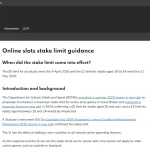
A specialist review reports that Great Britain’s online-slot stake limits are £5 for each game cycle for customers aged 25 and over, and £2 for those aged 18 to 24. Treat that as a reported rule, not as a reason to assume every game screen will explain its stake structure in the same way. Check the amount shown before you play, and make sure you understand what the selected bet covers.
UK Stake Limits
Reported online-slot stake limits in Great Britain are £5 per game cycle for customers aged 25 and over, and £2 for those aged 18 to 24.
That last part caught me out. In a 5 reel slot game, one bet can be applied across all five reels. The amount displayed as your stake may therefore relate to the whole game cycle rather than to a single reel. The layout and controls vary between games, so read the game’s own information and inspect the stake setting instead of judging it from a button or a familiar-looking interface.
No hidden arithmetic.
This is also why a low-looking button value can be misleading if you have not checked how the game applies the bet. I once focused on the number I could see and clicked through without properly reading what it represented. That was my mistake, not a trick to decode: pause long enough to confirm the total stake for the cycle. If the controls or wording are unclear, leave the game rather than guessing.
Online slot sessions are also shaped by rules about how a game cycle proceeds. In Britain, an online slot spin must last at least 2.5 seconds before another game cycle can begin, and autoplay is banned. So a screen cannot simply run a chain of automatic spins for you. You remain responsible for starting each cycle, which gives you a moment to notice the stake and decide whether you still want to continue. It is a small pause, not a safeguard against spending more than you intended.
The wider legal setting matters too. Remote gambling operators offering services to consumers in Great Britain must hold the relevant UK Gambling Commission licence, even when their key equipment is located elsewhere. That is about the operator’s permission to serve the market; it does not tell you how a particular slot’s stake is arranged. I keep those questions separate: first, whether the operator is authorised for the market; then, what the game will take for the next cycle.
A game’s information panel is worth opening before play, especially when you have not used that title before. Look for the stake controls and the game rules, then confirm the displayed total after changing anything. Don’t assume a setting carries over as you move between games. A familiar-looking reel layout can still present its bet controls differently.
Progressive Slots Online UK: How Jackpots Work
There is a difference between choosing an online slot because its return figure sounds appealing and understanding what a session will ask you to stake. The figure does not explain whether a displayed bet covers one line, multiple lines, or the full reel layout; the game’s own controls and rules do that. If you are comparing options, take a moment with those details before treating the game as ready to play. I have learned that the hard way.
For me, the practical routine is simple: check the stake, check what it applies to, and start only when both are clear. That won’t predict how a session goes, and it won’t make a game a good fit. But it does stop a preventable surprise at the point where a bet is placed. No guesswork.
High-RTP Slot Games: What You Can Assess Without a Name List
A list of slot names can look useful, but the title alone tells you very little about how a game is set up. I’ve clicked into games because the name or artwork looked promising, then realised I hadn’t even checked how the stake was applied. That’s a poor way to choose.
Start with the game’s own rules and layout. Look at the reel arrangement, the way winning combinations are formed, and whether the displayed stake is for one line or for the whole spin. Those details help you understand what you are actually selecting, rather than relying on a label such as “high RTP” to do all the work.
A 5 reel slot game can apply a bet across all five reels. So don’t assume that a stake shown beside the game describes a single reel or a single line. Check the on-screen controls and game information to see what the selected bet covers before you start. Easy to miss.
That also explains why a list of games without context can be misleading. Two titles may both be described as online slots, yet their layouts and betting interfaces may differ. A name list cannot show you how the game presents its stake options or what the displayed settings mean. You need to inspect the individual game.
I wouldn’t treat a polished title or a “best” label as evidence that a slot suits you. Read the rules in the game itself, find the information about its structure, and make sure the stake shown is the one you intended. If that information is hard to find, I’d rather move on than guess. No guesswork.
This is a more useful way to approach real-money play than hunting for a supposedly definitive list of high-RTP slot games. It won’t tell you how a session will go, and it doesn’t turn a game’s presentation into a promise. It does help you understand what you’re about to play and how your bet is being used.
When you compare online slots, keep the questions practical: what does the screen show, how are the reels arranged, and where do the rules explain the betting setup? A game’s name is a starting point, not a reason to trust a claim. Check the game, not the sales pitch.
Low Volatility, High RTP: Smaller Wins and Longer Runs
Low volatility is about the shape of a slot’s returns, not a promise that you will keep winning. A low-volatility game tends to spread its payouts across frequent, smaller wins. A high-volatility game tends to pay less often, with larger wins when they arrive. That difference can make one game feel steadier and another more stop-start, even when both are described as having a high RTP.
I used to treat “low volatility” as code for a safer session. It isn’t. A run of small wins can soften the feeling of a losing stretch, but it does not guarantee that your balance will hold up. The label describes a general pattern, not what the next spin will do. Small wins can still be smaller than the stakes that produced them. They can also stop arriving for a while.
Across most low-volatility titles, winning combinations tend to show up at an average interval of three to six spins. That is a broad description of how these games are designed, not a timer you can rely on. You might see several wins close together, then go longer without one. And “win” can mean a payout that returns less than the amount you staked. I learned that distinction the annoying way.
Low Volatility
Returns value through frequent, smaller wins, often creating a steadier feel.
High Volatility
Pays out less frequently, but tends to offer larger wins when they arrive.
Medium Variance
Sits between the two patterns, offering a balance of win frequency and size.
What low volatility can look like
Low-volatility slots often use familiar layouts: 5 reel slot games with at least twenty-five paylines are common. They may have fixed jackpot amounts rather than a progressive pool that grows as players contribute. Bonus rounds may build on wins already collected, applying multipliers to those accumulated amounts.
Those features can suit a design built around repeated, modest payouts instead of rare, dramatic ones. But they are clues to the game’s structure, not proof that it will deliver a gentle session. Paylines do not tell you how much a winning combination pays, and a multiplier in a bonus round does not mean the bonus will arrive when you want it.
A slot can have a high RTP and low volatility at the same time: the first describes its theoretical return over extended play, while the second describes how wins are generally distributed. Neither label predicts the result of a particular session. If you are looking for the highest-RTP low-volatility slots, the useful question is not just whether both labels appear together. You also need to understand what the game means by them and whether the claims apply to the version you are actually playing.
That last detail matters because a label can sound more precise than it is. “High RTP” is not a description of frequent wins, and “low volatility” is not a synonym for high RTP. One concerns the stated long-run return; the other concerns the typical rhythm and size of payouts. Reading them as interchangeable can lead you to choose a game expecting a regular stream of worthwhile returns. Not the same thing.
Choosing by feel, not by a promise
If you prefer smaller payouts appearing more often, a low-volatility design may feel less abrupt than a high-volatility one. If you would rather accept longer dry spells in exchange for the possibility of larger payouts, a higher-volatility design may suit your preferred pace. Those are preferences about how play feels, not a method for making a slot favourable.
High Volatility Slots in the UK: How They Work
I would not treat “low variance” as a separate shortcut to a better pick, either. It is another way people refer to a less swingy pattern, not a guarantee that the game will return more during your session. Likewise, seeing a percentage above a threshold in an advertisement does not establish that the game is low volatility. Check the RTP and volatility information as separate details, and avoid assuming a title has the same configuration everywhere.
There is no honest way to turn these labels into a reliable list of the best games without checking the individual game information. A name alone tells you little about its return profile or payout pattern. Even a combination that sounds ideal—high RTP, low volatility, frequent wins—still leaves the session uncertain.
I find it helps to decide what kind of play I can tolerate before I start: smaller, more regular-looking payouts, or fewer and potentially larger ones. Then I try not to mistake a string of small wins for evidence that the game is “due” to keep paying. The labels can help you understand the design. They cannot schedule your next win.
Understanding Slot Labels
- RTP is a theoretical long-run average, not a session prediction
- Volatility describes the rhythm and size of payouts, not the total return
- High RTP and low volatility are separate design features
- Neither label can schedule a win or guarantee a specific outcome
RTP and Variance: Why a Session Can Feel Different
RTP and variance describe different things. RTP is about a game’s theoretical return over a long run; variance is about how wins may be spaced out and sized along the way. I used to read a strong RTP figure as a hint that a session would feel kinder. It doesn’t tell you that.
A low-variance game tends to return value through more frequent, smaller wins. A high-variance game tends to pay less often, with larger wins when they land. Medium variance sits between those patterns, but the label is not a schedule: it cannot tell you when your next win will come, or how much it will be.
That is why two slots with similar RTP can feel completely different in a short session. One may produce several modest returns; another may leave longer gaps before a larger result. Neither experience, by itself, proves that the game’s RTP has changed. And a winning streak is no more a forecast than a dry spell is evidence that a payout is “due”.
The same distinction matters when a game is advertised with enhanced RTP. The phrase may sound like a promise of a smoother ride; it is not. A return figure and a variance description answer separate questions, and neither predicts the result of your next spins. Check the actual game information rather than treating promotional wording as a guide to session outcomes.
I’ve made that mistake: after a quiet stretch, I assumed the game had to turn around. It didn’t owe me anything. If a game has a positive house edge, its expected result for the player remains negative over enough play, whether losses arrive in small steps or uneven bursts.
Different rhythm. Same maths.
RTP Slots in the UK: Set a Limit Before You Spin
I used to treat a favourable RTP figure as a reason to stay longer. It felt like I’d found a better deal, so I’d keep playing after I’d already spent more than I meant to. That was the mistake: a figure can describe a game’s long-run maths, but it cannot turn a session into a safe bet.
If a game has a positive house edge, its mathematical expectation is negative over enough sessions. The losses can arrive gradually, but gradual is not the same as harmless. A run of small wins can make you feel as if your balance is holding steady, while the money you put in keeps adding up. I learned that the hard way.
So before I spin, I decide what I can afford to lose and treat that amount as spent. I don’t raise it because a slot seems generous, because I’m close to a bonus, or because I want to get back to even. Those are all reasons I’ve used to ignore my own limit. None improved the maths.
A limit only works if it is set before the excitement starts. Choose a stopping point for spending, and stop when you reach it. If you find yourself changing the rule mid-session, take that as a cue to step away rather than negotiate with yourself. A break is better than chasing.
I also try not to use money I need for bills or other commitments. That sounds obvious when you’re calm; it becomes less obvious when you’re focused on the next spin. Keeping gambling money separate makes the boundary easier to see. If losing the amount would put pressure on your day-to-day life, it is too much for a slot session.
Looking for the best RTP slots can be part of comparing games, but “best” is not a promise of profit. A higher-sounding figure does not cancel a positive house edge, and it cannot tell you what will happen to your balance tonight. I now treat RTP as information, not permission to stretch a budget.
My rule is simple: decide the limit first, stick to it, and leave when it is reached. No recovery plan. No “one more spin.” That’s the bit that matters.
Games

Aviator Casino Game UK: Licensing and Play Guide
A practical look at licensing, slot rules, cash play and the limits of claims about...

3-Reel Slots in the UK: How to Find a Game
Lobby labels and artwork can be misleading, so check the game details, rules and preview...

Five-Reel Slots UK: Online Play and Safety
Five reels describe a game's format, while the UK Gambling Commission's public register helps verify...

Bonus buy slots in the UK: demos, stakes and limits
A practical guide to demo play, feature costs, volatility and session limits, with clear boundaries...

High Volatility Slots in the UK: How They Work
High-volatility slots tend to pay less often, with larger wins when they land; that pattern...

Low-Volatility Slots in the UK: RTP and Real Sessions
RTP describes a theoretical return over extensive play, while volatility shapes how results may vary...

Progressive Jackpot Slots: How They Work and Pay
Progressive slots pool part of wagers into a growing prize, while game rules, casino networks...

Best Video Slots UK: How the Games Work
A practical guide to reel patterns, bonus features, browser play and the difference between demo...

Casino Dice Games in the UK: Rules and Formats
Dice-themed games can follow different rules and formats, making the instructions and platform terms important...

Chicken Road game in UK casinos: format guide
The game’s name and artwork do not establish its format; the way it is played...

Classic Slots Online in the UK: How They Work
Learn how reel combinations, paytables and familiar extras shape classic slots, and why a simple...

Crash casino games in the UK: regulation and play
The guide distinguishes UKGC-regulated operators from offshore sites and outlines checks on games, payments, demos...

Fruit Machine Slots UK: Pub Cabinets to Online
Online fruit slots keep familiar symbols and spins while replacing the physical cabinet with software,...

UK Casino Sites for Slots: What to Check
From operator authorisation and published game details to wagering terms and session limits, the guide...

Highest RTP Slots in the UK: How the Figures Work
RTP is a long-run mathematical expectation, while reel design, volatility and game settings can shape...

JetX Casino Game in the UK: What to Check
A look at JetX’s category label, demo limits, UK casino context and the checks to...

Mines Casino Game UK: Rules, Licensing and Risks
A Mines game’s name does not establish whether its operator holds the licence required to...

Online Casino Games for Real Cash in the UK: What to Know
A practical guide to slot odds, withdrawal routes, spending limits and bonus terms for UK...

Penny Slot Machines in the UK: Costs and Play
A practical guide to low-stake slots, covering total spin costs, free play, randomness, RTP and...

Plinko Casino UK: Real-Money Play and Regulation
A practical look at Plinko randomness, free play, payments and the difference between UKGC-regulated operators...

Progressive Slots Online UK: How Jackpots Work
Progressive prizes grow through wager contributions on connected games, while trigger rules and odds depend...

Online casino payouts in the UK: how RTP works
RTP describes a slot’s theoretical long-run return, not the result of an individual session or...