Casino No ID Verification UK: Checks and Withdrawals
 Available in GB

“No ID” often describes when checks happen, while age and identity verification may still be required before play or withdrawal.
Table of Contents
- What “No ID” Actually Means When You Play Online
- UK-Licensed or Offshore: The Trade-Off Behind Delayed Checks
- Slots Without ID Checks? Expect Verification Before You Cash Out
- The 2026 Reality: “No Verification” Usually Means Later Verification
- Real-Money Games and Free Spins Still Come With Checks
- Withdrawals: Verification, Approval and the Wait for Funds
- How to Judge a “Best” No-ID Casino Without a Top-List Promise
- Free Spins on Slots: Don’t Mistake an Offer for No-KYC Play
- Paying by Mobile: Deposits Don’t Guarantee Easy Withdrawals
- Crypto Casinos and Verification: Faster Transfers Aren’t Anonymous Play
- Safety
What “No ID” Actually Means When You Play Online
I used to read “no ID” as a promise that a casino would let me sign up, play and take out a win without ever asking who I was. That is not what it reliably means. In many cases, the phrase is about when a check happens, not whether the operator will check you at all.
For online gambling in Great Britain, the rule is clear: a gambling business must verify your age and identity before you gamble. A site cannot make that obligation disappear by labelling itself “no ID”, “no verification” or “no-KYC”. If a page suggests you can play real money games without any age or identity checks, treat that as a warning, not a useful shortcut.
The timing can still feel different from one site to another. UK-licensed casinos often ask for full KYC — know-your-customer checks — before you make your first deposit. Some operators outside the UK licensing system may postpone a fuller document review until you try to withdraw. That delay can make registration seem effortless, but it does not mean the operator has promised never to verify you.
If you’re looking for a UK casino with no ID verification, check each operator’s verification policy before signing up; payout speed alone does not confirm whether checks may be required. The details below give you the only available fact for each entry.
1. Amunbet
Payout speed: 1-3 business days Amunbet lists payouts at 1–3 business days. This timing does not establish whether ID verification is required.
2. Revery Play
Payout speed: 1-3 business days Revery Play lists a payout speed of 1–3 business days. Check its verification policy separately if avoiding ID checks is important to you.
3. EvoSpin
Payout speed: 1-3 business days EvoSpin’s stated payout speed is 1–3 business days. No information is provided here about its ID verification requirements.
4. Britsino
Payout speed: 1-3 business days Britsino lists payouts at 1–3 business days. You’ll need to confirm its verification requirements directly.
5. SpinFormula
Payout speed: 1-3 business days SpinFormula gives a payout speed of 1–3 business days. That detail alone does not indicate whether ID checks apply.
6. WinBeast
Payout speed: 1-3 business days WinBeast lists a payout speed of 1–3 business days. Its ID verification policy is not specified in the available information.
7. SlotoSport
Payout speed: 1-3 business days SlotoSport’s stated payout speed is 1–3 business days. Check with the operator to find out whether verification may be required.
8. NightLuck
Payout speed: 1-3 business days NightLuck lists payouts at 1–3 business days. No ID verification details are available here.
9. x3bet
Payout speed: 1-3 business days x3bet gives a payout speed of 1–3 business days. You’ll need to check its own terms for information about ID verification.
10. Zombillion
Payout speed: 1-3 business days Zombillion lists payouts at 1–3 business days. The available detail does not say whether ID checks are required.
That distinction matters. A quick sign-up is not the same thing as a completed account check. A site might collect basic details when you register, run an automated check behind the scenes, or request documents later if it needs to confirm your identity. Offshore operators may use electronic verification, often called eKYC, to check details automatically without asking you to upload documents at sign-up. “No photo ID at registration” can therefore describe one step in the process, not the whole relationship with the casino.
I learned the hard way not to treat a smooth registration screen as proof that everything is settled. You can get through the front door and still meet a verification request later. The check may involve confirming that the account belongs to you and that the personal details you supplied are accurate. If the operator cannot complete its checks electronically, it may ask you for supporting documents.
The phrase “no ID needed” also blurs several different things. It might mean no document upload at the point of registration. It might mean the operator accepts electronic checks rather than asking for a photograph of a passport or driving licence straight away. Or it might be marketing language that leaves out what happens when you request a payout. Those meanings are not interchangeable, and the wording alone does not tell you which process the casino follows.
No ID Verification Withdrawal Casinos in the UK
That is why “no photo ID” should not be read as “no identity check”. A player may not be asked to photograph an identity document at the start, but the operator still has to establish age and identity before gambling under the rules that apply in Great Britain. A later request can be inconvenient, especially if you assumed registration meant the account was fully cleared. It is better to understand the distinction before depositing than to discover it when you want access to your money.
There is another point I wish I had paid attention to: a site’s claims do not override the law. If a casino says that no one will ever ask for identification, that claim does not prove the operator can lawfully let a Great Britain customer gamble without checking age and identity. Nor does “instant play” explain what checks have been done in the background. The language on a landing page is not a substitute for understanding the operator’s process.
So if you are considering an online casino that appears to require no ID, read the claim narrowly. Ask yourself whether it is talking about registration, deposits, gameplay or withdrawals. Look for clear terms explaining when verification can happen and what documents might be requested. If those terms are vague, do not fill in the gaps with the most convenient interpretation.
I still understand the appeal. Nobody wants to scan documents just to find out whether a site works for them. But the honest expectation is simpler: some checks may be automated or delayed, while age and identity verification remain part of the process. A casino that appears to ask for less at the start may simply be asking later.
Attention: A site claiming you can play real money games without any age or identity checks should be treated as a warning, not a useful shortcut.
“No ID” isn’t “never.”
UK-Licensed or Offshore: The Trade-Off Behind Delayed Checks
When a site advertises “no ID”, the detail I look at first is not the games or the welcome banner. It is which regulator, if any, is responsible for the operator. That tells you more about the arrangement than the slogan does.
A UK-licensed casino and an offshore casino are not two versions of the same service with different paperwork. A UK Gambling Commission licence means the operator is inside the British regulatory system. An offshore licence comes from another jurisdiction; it does not make the casino UKGC-licensed, even if the site accepts British players or displays familiar payment options.
That distinction matters because operators offering remote gambling to people in Great Britain are required to hold a UK Gambling Commission licence. A site operating under an overseas licence is not thereby authorised to target the British market. UK residents may be able to play at an overseas-licensed casino where the operator is not illegally targeting the UK, but that is different from saying the operator is UK-regulated. Don’t blur those points.
When the checks happen
The “no ID” pitch often describes timing, not an exemption. UK-licensed casinos almost always check identity at some point, and they often complete fuller checks before the first deposit. Offshore casinos commonly leave full verification until the first withdrawal, though they may use electronic checks earlier and can ask for information at other stages.
That difference can make registration feel easier at an offshore site. You might get further into the account before being asked to provide documents. But if a casino requests identity information when you try to cash out, that is still verification. I used to treat “not asked yet” as “won’t be asked”. Bad reading of the situation.
No account casino UK: what to check first
Nor does an overseas licence mean every operator follows the same process. A site can make checks earlier, or request further information later. The headline is not a promise about your account. Read the terms and the verification policy before depositing, and be prepared for the possibility that access to funds depends on satisfying the operator’s checks.
GamStop is a separate question
Licensing also changes whether the casino is connected to GamStop. UK-licensed operators must integrate with the national self-exclusion scheme. Non-GamStop casinos are sites without a UK Gambling Commission licence, so they are not part of that system; an overseas regulator does not substitute for GamStop.
That is not a workaround I would point someone towards. If you have self-excluded through GamStop, an offshore site may not be covered by that exclusion, and its availability does not cancel the reason you set the block in the first place. I would treat the absence of GamStop as a meaningful difference in protection, not a selling point.
This is one reason “non-GamStop” and “no-KYC” should not be lumped together. The first describes a site’s relationship to UK licensing and the self-exclusion scheme. The second is a marketing label about identity checks. A non-GamStop casino can still ask for documents, and many do before approving a withdrawal. Neither phrase tells you that the operator will skip verification.
Do
- Check the operator’s license on the public register
- Read verification and withdrawal policies before depositing
- Distinguish between licensing, verification timing, and GamStop
Don’t
- Treat a smooth registration as proof of no future checks
- Use the absence of GamStop as a selling point
- Assume an overseas license authorizes targeting the UK market
What the trade-off really is
With a UK-licensed site, you are dealing with an operator required to meet UK rules, including the connection to GamStop. The trade-off is that identity checks may happen sooner, sometimes before you can deposit. With an offshore site, checks may be delayed, but you are outside the UKGC system and the site is not required to participate in GamStop. Easier registration is not the same as stronger protection.
So when you see claims about a casino with no ID check in the UK, separate three things: where the operator is licensed, when it asks for verification, and whether GamStop applies. They answer different questions. A site’s overseas licence does not turn it into a UK-licensed casino, and a later check is still a check.
I know the delayed version can look tempting when you just want to get started. But the point at which you are asked for documents can be the moment you most want access to your balance. That is not a reason to assume trouble; it is a reason to understand the arrangement before you play. Read the licence information, the verification terms and the self-exclusion position as separate parts of the decision.
A “no ID” label can make the offshore option sound simpler. In practice, you are weighing earlier checks and UKGC oversight against the possibility of later checks outside that system. The label does not settle which matters more to you. It only tells you where to look next.
Merkur Casino Online UK: Games, Sites and Safety
Slots Without ID Checks? Expect Verification Before You Cash Out
A slot game cannot make an identity check disappear. I used to treat “no ID” as a feature of the game: pick a machine, sign up quickly and worry about the paperwork later. That was the wrong way round. The operator, not the slot, decides what checks apply.
For real-money gambling in Great Britain, the UK Gambling Commission requires online gambling businesses to confirm a customer’s age and identity before they gamble. That applies whether you choose a classic fruit-style game, a themed reel game or something else entirely. A different game title does not create a different route around the rules.
So when a site advertises slots with no ID checks, read the claim as a description of its sign-up process, not a promise that you can play real money without being identified. On a UK-licensed site, the required checks must happen before gambling. If an offer seems to say otherwise, don’t assume the game itself is exempt.
The wording gets murkier around non-GamStop casinos and no-KYC casinos. Some offshore sites may let a customer register without completing full checks at that point. But most non-GamStop casinos still ask for identity documents before approving a withdrawal, despite using “no-KYC” in their marketing. That can leave you able to play for a while, then unable to collect winnings until the operator has checked who you are.
That is not a small technicality. It changes what “no ID needed for real-money slots” means in practice. It may mean no documents requested during registration; it does not establish that the site will never ask for them. And a slot’s result or the size of a win does not settle the question. The operator can still require verification before releasing funds.
Real-money gambling in Great Britain requires the operator to confirm a customer’s age and identity before they gamble, regardless of the specific slot game chosen.
I learned not to read a short banner as the full terms. “No verification” sounds final; the conditions may tell a less exciting story. Before putting money in, look for the operator’s identity-check and withdrawal rules. If the wording is vague about when documents can be requested, treat the claim cautiously rather than assuming the checks have been waived.
There is another distinction worth keeping straight: free play is not the same as real-money play. Trying a slot in a free-play mode does not show that you can use the same game for cash without checks. Likewise, a “no deposit” label describes how an offer is funded, not whether the operator has to verify a player. A promotion can change the way you access a game; it cannot turn a real-money slot into an identity-free activity.
I would also separate “best slots” from “best conditions”. A game can look appealing, but that tells you nothing about when the casino will request documents or whether it will approve a withdrawal. There is no useful ranking of games that can answer an operator-level question. Check the rules attached to the casino account, not just the slot page or promotional headline.
If you are only looking to play without staking money, make sure the game is clearly presented as free play and do not mistake a practice session for proof about cash withdrawals. If you plan to deposit and play for money, assume the operator may need to establish your identity. For a UK-licensed casino, age and identity checks must come before you gamble. At sites using a delayed-check model, documents may still be required before a withdrawal is approved.
Non-GamStop Curaçao casinos: what the licence means
The reel doesn’t decide. The operator does.
The 2026 Reality: “No Verification” Usually Means Later Verification
“No verification” sounds like a promise that you can sign up, play and take your money without proving who you are. I used to read it that way too. The less exciting meaning is often that the site does not ask you to upload documents at registration. That is a difference in timing, not proof that checks will never happen.
For a UK-licensed casino, the label needs particular caution. The UK Gambling Commission requires age and identity checks before a customer gambles, and UKGC-licensed casinos almost always verify customers at some stage. A smooth registration page does not cancel that requirement. If a site presents itself as available to British players while claiming that no checks are needed at all, I would treat that as a warning, not a perk.
With an offshore casino, the sequence can look different. It may let you register and play before asking for identity documents, then request them when you try to withdraw for the first time. That is why “no ID” and “no KYC” can be used to describe a sign-up experience that feels light on paperwork, even though a check is still waiting further down the line.
Why “no verification” is often misleading
It frequently refers to the registration stage only, meaning no documents are uploaded at sign-up. However, verification may still occur via automated electronic tools behind the scenes or be required later during the withdrawal process.
That distinction is easy to miss when you are focused on getting started. The registration form may ask for basic details, and the account may appear ready to use. Then, when you ask to cash out, the operator may need documents to confirm who you are. The earlier lack of a document request is not a guarantee about what happens later.
Some checks can also happen electronically. A casino may use automated identity-checking tools without asking you to send a file at sign-up. So the experience can look like “no verification” from your side, even while the operator is checking information behind the scenes. And if that process does not settle the question, it may still ask you for documents later.
I’d now read the wording as a claim about the first steps, not the whole account. Does it mean no document upload during registration? Does it mean checks are delayed until a withdrawal? Or is the wording simply vague? Those are different situations, and a banner rarely explains which one applies. Look for the operator’s own terms on verification and withdrawals before treating the phrase as meaningful.
There is no reliable way to infer from a quick registration that a future cash-out will be uncomplicated. A request for documents can arrive after you have already played, which is the point at which the “no verification” promise can feel very different. Better to expect that identity checks may happen than to plan around the hope that they will not.
The wording sells convenience. The timing tells the story.
Non-Gamban Casinos in the UK: What the Label Means
In practical terms, a casino no-ID claim is not the same thing as permission to play anonymously or withdraw without checks. If you are comparing no-ID casinos in the UK, the useful question is not simply whether documents are requested today. It is whether the operator explains when it may verify you, and whether you are comfortable with that process before putting money into the account.
“No verification” can mean fewer questions at the door. It does not mean there is no door to pass through later.
Real-Money Games and Free Spins Still Come With Checks
A game and the casino running it are not the same thing. A table game, a live game or a free-spin offer may be presented as “no ID”; that wording describes the pitch, not a separate set of rules for the game. If you are gambling online for real money in Great Britain, the operator must check your age and identity before you play. A promotion cannot cancel that obligation.
I used to treat a bright offer label as if it settled the practical details. It doesn’t. “No ID free spins” might mean the offer is easy to claim, or that documents are not requested at the point of registration. It does not establish that the operator will let you gamble for real money without verifying you. The same applies to a casino game advertised as playable without ID: the game itself cannot waive checks imposed on the business providing it.
That distinction matters with free spins because the promotion can look separate from the rest of the account. You may see spins described as free or available without a deposit, but they are still offered by a casino operator. Read the terms for eligibility and any conditions attached to the offer, and do not treat the wording as proof that identity checks have been removed. The offer is one thing. Your account is another.
Promotional labels like "no ID free spins" do not waive the legal obligation for operators to verify your identity before real-money gambling.
If a site presents itself as a no-KYC casino, that label also needs a careful reading. A specialist casino review describes possible checks that can extend beyond an identity document, including address and contact details, and source-of-funds information. What is requested can depend on the operator and the circumstances. The useful takeaway is not that every player will face every document request; it is that “no ID” is not a sound promise that no verification will ever be needed.
This applies to real-money play across different kinds of casino games, not just one category. Nor does changing the payment method change the operator’s responsibility to verify you. Crypto is not a magic side door; the payment choice and the casino’s checks are separate matters.
Before you claim an offer, look for wording about account verification and eligibility, not just the headline. If the site says documents may be requested, take that seriously. If it says nothing clear, do not fill the gap with the assumption that you can play and withdraw without being identified. I learned the hard way that the headline is rarely the whole deal.
No loophole in the spin.
Withdrawals: Verification, Approval and the Wait for Funds
A withdrawal request can be the point when a casino asks you to prove who you are. That catches people out when a site has advertised itself as “no-KYC”: the label may describe what happens at registration, not what is required before money is released. Most non-GamStop casinos still ask for identity documents before approving a withdrawal. No documents at sign-up does not mean no checks at cash-out.
Online casino Malta MGA licence in the UK
I would treat the first withdrawal as a separate step in the process, not as a button that sends money straight to your account. The casino may need to review the request and any documents before it approves the payment. If it asks for paperwork, follow the instructions on the account and make sure the details you submit are readable and consistent with your registration. Until that review is complete, the request may remain pending.
Then there is the payment itself. A useful distinction is between casino approval and payment settlement. Approval is the operator’s decision to release the withdrawal; settlement is the transfer being processed afterwards. So a status showing that a request has been approved does not necessarily mean the money has already arrived. Equally, a delay before approval is not the same thing as a delay in the payment network.
That distinction matters when you are trying to work out where a cash-out is stuck. If the casino is still reviewing documents or the withdrawal request, the payment has not reached the settlement stage. If the operator has approved it, the remaining wait concerns the transfer. I would check the account status and any messages from the casino before assuming that the two stages are one continuous process.
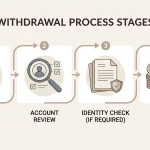
Withdrawal Process
- No documents at sign-up does not mean no checks at cash-out
- Casino approval of a withdrawal is separate from payment settlement
- Some offshore casinos may impose monthly withdrawal caps
- Verification requests may include identity, address, and source of funds
There may also be a limit on how much an operator will pay out over a given period. A specialist review has reported that some offshore casinos set monthly withdrawal caps, which can affect how quickly a large win is paid in full. That is a report about some operators, not a rule that applies everywhere; the relevant terms are the ones published by the casino you are considering. A cap can make the timing different from a document review or payment-processing delay.
The practical lesson is to read the withdrawal terms before you deposit, including what documents may be requested and whether payout limits apply. Save the casino’s messages and note whether your request is awaiting approval or has moved to payment. Those details help you identify the stage of the process without mistaking “pending” for a promised arrival time.
“Fast withdrawals” sounds simple. The stages aren’t.
How to Judge a “Best” No-ID Casino Without a Top-List Promise
I’m wary of any site calling itself the “best” no-ID casino. That label can make a delayed check sound like a missing one, and those are not the same thing. In practice, the difference is often when the operator asks for your details: offshore casinos typically request identity verification before processing a first withdrawal. A smooth sign-up tells you little about what happens when you try to cash out.
I’d start by looking past the banner and finding the operator’s legal name and licence number. Then check that number on the public register of the regulator said to have issued the licence. Make sure the record matches the company you’re dealing with; a logo on a website is not the same as a verifiable entry. If there’s no clear operator identity or the licence details don’t match, I’d treat that as a reason to stop, not a puzzle to solve with a deposit.
Safe Online Casinos in the UK: Licence and Checks
There’s another distinction worth keeping straight. A foreign licence, even when it can be verified, is not a UK Gambling Commission licence. Remote operators offering gambling to people in Great Britain are required to hold the relevant UK licence. So don’t read an overseas regulator’s register as proof that the site is authorised to serve British players.
I’ve learned not to treat “no-KYC” as a promise about the whole journey. Ask yourself what the wording actually says: are checks postponed until withdrawal, or does the operator make a clear claim that they will never happen? The latter is not a safe assumption. Be prepared for an identity check before a withdrawal is processed, and read the site’s verification terms before handing over money or documents.
No ranking can settle this for you. Check who operates the casino, verify the stated licence, and understand when checks may occur. If those basics are hard to confirm, “best” is just a sales word. Not a safeguard.
Free Spins on Slots: Don’t Mistake an Offer for No-KYC Play
A slot promotion and an account check are two separate things. “Free spins” describes what the casino is offering; it says nothing about whether you’ll be asked to prove who you are. The same goes for “no-KYC” wording beside a slots offer. That label isn’t permission to play without checks.
Legal Requirement
In Great Britain, an online gambling business must verify your age and identity before you gamble; any claim to the contrary is not a legal substitute for this requirement.
In Great Britain, an online gambling business must verify your age and identity before you gamble. A bonus page cannot cancel that requirement. If a site lets you claim spins, that alone does not show that its checks have been completed—or that it will skip them later. Read the terms, but don’t mistake promotional wording for a promise about verification.
I used to treat the offer as the whole deal. It isn’t. You’re dealing with both the slot promotion and the operator’s account process, and one doesn’t settle the other. “No ID” may sound like a feature attached to the spins; it does not make the spins a way around identity checks.
Before playing, look at what the site says about account verification and what information it may request. If the wording is vague, assume the offer does not answer the question. Don’t count potential winnings as withdrawable money until you understand the checks attached to the account.
Free spins are still play. The label doesn’t change that.
Paying by Mobile: Deposits Don’t Guarantee Easy Withdrawals
Paying through your phone bill can look like the neatest option: select Boku, confirm the charge, and the deposit is done. The catch is what happens when you want the money back. A specialist review reports that Boku and similar mobile-payment methods at offshore platforms are for deposits only. They are not a route for receiving withdrawals.
That distinction is easy to miss when a cashier displays a mobile option beside cards or other payment methods. A deposit button tells you how money can go in, not how it can come out. Before using it, I’d check the platform’s withdrawal rules and make sure you have a separate, supported way to receive funds. Don’t assume the same phone-billing option works both ways.
And “no ID” does not change that. A mobile payment method is not proof that a casino will skip identity checks, nor does it guarantee that a withdrawal will be approved. Payment choice and verification are separate issues; confusing them can leave you with a balance and no matching cash-out route.
Safety & Registration for UK Online Casinos
There is also a bigger point with offshore platforms: a payment option appearing in the cashier does not establish that the operator is authorised to serve people in Great Britain. The UK Gambling Commission says operators offering remote gambling to Great Britain consumers need its licence. Check the operator’s status, not just the deposit screen.
Convenient in one direction. That’s all.
Crypto Casinos and Verification: Faster Transfers Aren’t Anonymous Play
Crypto can make a cash-out sound simple: the casino sends funds to a wallet, and the transfer moves without a bank card. But that describes the payment rail, not the checks the operator may apply to you. A “no-KYC” label is not a promise that you can withdraw without proving who you are.
A specialist review reports that cryptocurrency withdrawals at serious offshore operators can take one to six hours. Treat that as a reported timeframe, not a guarantee for your account. The casino may still need to review and approve the withdrawal first; a fast crypto transfer cannot speed up a check that has not been completed.
The same kind of specialist review says verification requests at no-KYC casinos may cover your identity, address and contact details, as well as the source of your funds. That can mean being asked for documents after you have already deposited or played. Crypto does not remove that possibility, and it does not turn a gambling account into an anonymous one.
I would read “fast crypto payout” as a claim about transfer processing, not a shortcut around verification. Check the operator’s terms for its withdrawal and document rules before sending funds, and remember that an offshore casino is not a UK-licensed casino simply because it accepts crypto. The distinction matters if the operator asks for evidence before releasing money.
Fast transfer. Still your name.
What are the best payment methods for non-GamStop casinos?
For speed, cryptocurrency withdrawals can take minutes or one to six hours, while Skrill and Neteller withdrawals at established operators typically clear within 24 hours. Check fees and limits first: offshore bank transfers may cost £10 to £50, and Boku-style mobile payments are for deposits only.
Is it legal for UK players to use non-UK-registered casinos?
Yes, UK residents can legally play at an overseas-licensed casino provided the operator is not illegally targeting the UK market. An overseas licence does not make the casino UKGC-licensed.
Do non-UK-registered casinos accept credit cards?
Yes. Offshore casinos commonly accept Visa and Mastercard, and credit card gambling is banned at UK-licensed operators but remains available on independent offshore platforms. Deposits may incur fees of 2% to 5%.
Safety

Merkur Casino Online UK: Games, Sites and Safety
Merkur branding identifies a game, while the operator runs the casino and sets its account...

Most Trustworthy Online Casinos UK: What to Check
A practical way to assess licensing, operator obligations, non-GAMSTOP status, payments and bonus terms before...

No account casino UK: what to check first
A quicker-looking sign-up route does not remove player records, age checks or the need to...

No ID Verification Withdrawal Casinos in the UK
UK rules require age and identity checks before play, while withdrawal timing and payment methods...

Non-Gamban Casinos in the UK: What the Label Means
Gamban blocks access on devices, while GAMSTOP is a national scheme for self-exclusion across participating...

Non-GamStop Curaçao casinos: what the licence means
A Curaçao label describes a licensing connection, but it does not establish that a casino...

Non-GamStop European Casinos: UK Rules Explained
A European address does not establish UK authorisation or change the importance of an existing...

Online casino Malta MGA licence in the UK
A Malta authorisation is separate from UKGC permission, which operators need to offer remote real-money...

Online Casino No Registration in the UK: Explained
A shorter sign-up does not remove identity checks, which can affect deposits, bonuses, game access...

Safe Online Casinos in the UK: Licence and Checks
A practical look at UKGC licensing, account limits, self-exclusion and the checks that shape safer...
Trusted UK casinos: how to check a licence
A practical way to assess licensing, site domains, terms, payment controls and trust claims before...