Progressive Slots Online UK: How Jackpots Work
 Available in GB

Progressive prizes grow through wager contributions on connected games, while trigger rules and odds depend on the slot.
Table of Contents
- What Makes a Jackpot Progressive?
- How to Try Progressive Slots for Free
- Finding a Progressive Slot You Can Actually Play
- What to Look for in a Progressive Slot
- How Progressive Jackpots Trigger—and What It Takes to Hit One
- RTP, Odds and the Cost of Chasing a Jackpot
- Playing for Real Money: Bets, Verification and Payouts
- Progressive Slots in the UK: Licensing and Player Controls
- What Does “Penny Progressive” Mean?
- Progressive vs Non-Progressive Slots: Where the Payout Goes
- Games
What Makes a Jackpot Progressive?
The word “progressive” describes what happens to the jackpot as people play: wagers on connected slot machines feed a prize pool, which can grow while the jackpot remains unclaimed. The prize is not simply a fixed amount printed on the game and left unchanged. Its value moves with play.
I used to picture a jackpot as something the casino had set aside in advance, like a pot that stayed the same until somebody won it. That is not the key idea here. In a progressive jackpot slot, contributions from wagers add to the pool. The game connects those contributions to a jackpot whose value can increase over time. The pool is part of the game’s structure, not just a headline attached to a large-looking prize.
A useful way to picture it is a shared container. Players place wagers on connected machines, and a portion of those wagers is channelled into the jackpot pool. The machines may be individual games, but their contributions can be linked to the same prize. So the jackpot is not necessarily built by one person playing one machine. Other people playing the connected game can contribute to that pool too.
When choosing progressive slots online in the UK in 2026, you may also want to consider how quickly you can receive a payout. This list gives you the payout-speed information available for each operator.
1. Amunbet
Payout speed: 1-3 business days Amunbet lists a payout speed of 1–3 business days. You can use this as a reference when considering how quickly you may receive a payout.
2. Revery Play
Payout speed: 1-3 business days Revery Play lists a payout speed of 1–3 business days. This gives you a stated timeframe to consider for payouts.
3. EvoSpin
Payout speed: 1-3 business days EvoSpin lists a payout speed of 1–3 business days. You can factor that stated timeframe into your choice.
4. Britsino
Payout speed: 1-3 business days Britsino lists a payout speed of 1–3 business days. That is the available detail on its payout timing.
5. SpinFormula
Payout speed: 1-3 business days SpinFormula lists a payout speed of 1–3 business days. You can refer to this stated timing when weighing payout expectations.
6. WinBeast
Payout speed: 1-3 business days WinBeast lists a payout speed of 1–3 business days. This is the available information about its payout timing.
7. SlotoSport
Payout speed: 1-3 business days SlotoSport lists a payout speed of 1–3 business days. You can take that timeframe into account when considering payouts.
8. NightLuck
Payout speed: 1-3 business days NightLuck lists a payout speed of 1–3 business days. This stated timeframe is the available payout detail.
9. x3bet
Payout speed: 1-3 business days x3bet lists a payout speed of 1–3 business days. You can use this as a reference for its stated payout timing.
10. Zombillion
Payout speed: 1-3 business days Zombillion lists a payout speed of 1–3 business days. That is the available detail to consider about its payouts.
That connection is what makes “progressive” more than a label for a slot with a big prize. A game can advertise a jackpot, but the defining feature here is that wagers add to a pool that changes as people play. If the prize were fixed and did not accumulate contributions from connected play, it would not work in this progressive way.
The scale of the connection can vary. A pool might be tied to connected machines within a single setting, or it might link copies of the same progressive slot across multiple operators. In the latter case, players do not have to be using the same operator for their wagers to feed the same network jackpot. If those operators carry the same progressive game as part of that network, the pool is shared across them.
That part surprised me when I first got my head around it. I had assumed that a jackpot shown inside one casino belonged only to that casino’s players. With a networked progressive, the game can connect play beyond one operator. The screen you see is local; the pool behind it can be shared more widely. A single operator’s game page does not necessarily show the full boundaries of the jackpot network.
This also explains why the same game can display a changing jackpot to players at different operators. They are not necessarily looking at separate prizes that happen to have matching names. If the game is part of a shared network, wagers placed through the participating operators contribute to the same pool. The operator is where you access the game; it is not automatically the sole source of the jackpot.
Online casino payouts in the UK: how RTP works
There is a small but important distinction between a game being available at several operators and its jackpot being shared between them. The shared-pool idea applies when the operators carry the same progressive slot as part of the network. Merely seeing a similar title or a similar jackpot display is not enough to establish that two games feed one pool. The connection is a feature of the progressive game arrangement, not something you can infer from the word “jackpot” alone.
When you look at a video slot with a progressive jackpot, then, try to separate the visible game from the pool it connects to. The reels, symbols and interface are what you play on screen. The jackpot pool is the accumulating prize linked to wagers on connected machines. A network can extend that connection across operators carrying the same game, so the pool can reflect play beyond the casino page you are using.
That is the basic mechanic behind progressive jackpot slots online in the UK: connected play adds contributions to a growing shared prize pool. It does not mean that every slot with a prize is progressive, nor does the word tell you by itself how a particular game awards its jackpot. Those are separate details. For now, the useful distinction is simple: progressive means the jackpot pool accumulates through wagers on connected machines, and the connection may reach across operators.
Penny Slot Machines in the UK: Costs and Play
I still find the word a little slippery in adverts. “Networked” can sound like a technical flourish, when it has a plain consequence: other players’ wagers may be feeding the same pool you see. The jackpot is shared infrastructure, not a private pot reserved for the operator’s own customers. Once that clicks, the number on the screen makes more sense as a moving pool rather than a fixed promise.
So if you are trying to understand what makes a jackpot progressive, start with where contributions go. They do not all remain attached only to the individual spin. Some are directed into a connected jackpot pool, and the pool can be shared among operators carrying that same game. That is the core of it. No mystery required.
How to Try Progressive Slots for Free
A free version is a way to get familiar with a progressive slot without staking your own money. If a casino or game provider offers a demo, you can open it in a browser and play with virtual credits; some games may also be available through a no-download option. Availability depends on what is offered, and a demo is not the same thing as a free-spin promotion or a no-deposit bonus.
Classic Slots Online in the UK: How They Work
The useful part is simple: you can see how the reels, features and on-screen jackpot display work before deciding whether the game holds your attention. I’ve learned not to confuse that with learning how likely a jackpot is to land. A run of demo spins can look lively or painfully quiet, but neither tells you what a cash session will do. Virtual credits have no cash value, and a demo result is not a preview of a future real-money result.
Demo play, free spins and no-deposit offers
These options can sound interchangeable in advertising, but the terms matter. Demo play uses virtual credits. Free spins let you play a set of spins under the promotion’s rules. A no-deposit bonus gives you bonus funds without first making a deposit, but it may still come with conditions before winnings can be withdrawn.
For progressive slots, the crucial detail is whether the promotion actually applies to the progressive game. A free-spin offer may be limited to selected titles, and a game’s jackpot feature may be excluded even if the game itself is listed. Read the promotion terms and the game rules together; the promotional banner alone doesn’t settle it.
A specialist review reports that free-spin winnings from progressive slots may be capped at £50–£100, and that most free-spin promotions are restricted to non-progressive games. Treat that as a report of terms found in some offers, not a rule that applies everywhere. The cap, eligible games and any jackpot exclusion can differ, so check the live terms before you start. “Free” can have fine print.
Do
- Read the promotion terms and game rules together
- Check the eligible game list
- Verify the withdrawal terms
Don’t
- Rely solely on the promotional banner
- Confuse demo play with a free-spin promotion
- Assume a bonus works like unrestricted cash
For no-deposit bonuses, a specialist review reports wagering requirements of 40x–60x and maximum withdrawal caps of £50–£100. Those figures describe terms reported by that source, not a guaranteed offer or a universal standard. Look for the wagering requirement, which games count towards it, the expiry conditions and the maximum amount that can be withdrawn. If the terms are unclear, don’t assume the bonus will work like unrestricted cash.
What a free trial can tell you
A demo can help you work out whether you understand the controls and enjoy the pace. It can show where the paytable and feature information sit, and whether the game is something you want to keep playing. That is enough to make a more informed choice about spending your time. It is not enough to judge the value of a promotion or the likelihood of a jackpot.
Free spins can be more useful for trying a game than a demo because they may involve a promotion’s actual rules. But they still don’t remove the restrictions attached to that offer. If progressive play is excluded, the spins won’t show you how that game behaves with its jackpot feature active. If the game is allowed but winnings are capped, the promotion may not reflect what a cash win could mean either.
I used to see a free offer and read the headline, not the conditions. That was backwards. Start with the eligible game list and the withdrawal terms, then decide whether the offer is worth trying. If you only want to explore a game, look for demo play and treat the credits as practice—not a bankroll.
3-Reel Slots in the UK: How to Find a Game
Free play is a low-pressure way to get acquainted with a slot, not evidence that it pays better or that a jackpot is within reach. Enjoy the test for what it is. Keep the distinction clear.
Finding a Progressive Slot You Can Actually Play
I’ve wasted time looking for a progressive slot by name, only to find it missing from the casino I had open. That isn’t necessarily a broken search or a game that has disappeared everywhere. Availability depends on the operator, and a catalogue can change when providers update the games they supply. A specialist review also notes that availability can vary between operators and change over time, so treat any list of titles as a snapshot, not a promise that you can play them today.
Start with the casino’s own games page. Search the exact title if you have one in mind, then check whether the result is actually available in your account rather than just mentioned on a promotional page. If there’s a filter for progressive jackpot slots, it can help narrow the catalogue, but I wouldn’t assume that every site labels or organises them in the same way. Sometimes the quickest route is to search the game title directly.
Take Gladiator: Road to Rome as an example of a named game someone might want to find. Its inclusion here is not a recommendation or a claim that every UK casino carries it. Look for the exact title in the operator’s current catalogue; if it doesn’t appear, try another UKGC-licensed operator rather than assuming the game is unavailable across the board. Even then, a result on a general web page doesn’t prove the game is currently playable at a particular casino.
Finding a Game
Search the catalogue
Use the casino’s games page to search for the exact title or use a progressive filter.
Verify account access
Check if the game is actually available to open within your specific account.
Confirm with the operator
If the title appears in a review but not in the game, ask the operator directly.
This is where “available” can mean two different things. A title might appear in an operator’s catalogue or an old review, while the game itself may not be accessible through your account. The practical check is whether the operator lists it as a current game and lets you open it. If you’re unsure, ask the operator directly. A screenshot or a search result can go stale; the live catalogue is the useful part.
I used to treat lists of the “best progressive slots” as if they were menus. They aren’t. A list may describe games that are popular or well known, but that doesn’t tell you which one you can access at the operator you use. Nor is there one fixed set of the most popular progressive slots across every UK casino. The catalogue in front of you matters more than a confident headline.
If you have no particular title in mind, browse the progressive category and note the games that are actually listed. You can then look up a specific title elsewhere if you want more information, but keep the two checks separate: one is whether you can play it; the other is whether it suits you. That second question is about the game itself, not its availability.
Five-Reel Slots UK: Online Play and Safety
People sometimes ask whether progressive slots are worth playing, or how to play them, as though finding the title settles everything. It doesn’t. Getting access only answers the first, basic question. Don’t let a game’s name on a list stand in for a check of the operator’s current catalogue—and don’t read a missing title as proof that you searched badly.
Simple, but easy to miss.
What to Look for in a Progressive Slot
A jackpot figure can grab your eye before you’ve even looked at the game. I’ve learned to pause there. A large prize tells you little about whether you’ll enjoy the slot, how its jackpot is organised or what the base game offers.
Start with the game’s information screen and paytable. Look for a clear explanation of the jackpot structure: whether the prize is one pool or divided into tiers, and what the game says about each tier. The wording should let you understand what you’re playing, not leave you piecing the rules together from promotional graphics. If the key terms are hard to find or vague, that’s useful to know before you commit to a game.
Then check what the jackpot is attached to. Some progressive slots present a single headline prize; others show more than one jackpot level. Don’t assume that a display tells the whole story. Read the game rules to see which prizes are progressive and how the game describes them. A number ticking upwards can make a slot feel more exciting, but it isn’t a guide to how suitable the game is for you.
Choosing a Slot
- Review the jackpot structure in the paytable
- Check if the jackpot is divided into tiers
- Evaluate the base game symbols and features
- Verify the return-to-player (RTP) information
- Test the readability of the help panel on your device
The base game deserves the same attention. Read the paytable for its symbols, combinations and bonus features, and check whether the game explains how those features work. The jackpot is only one part of the experience; you may spend far more time seeing the ordinary reels and features than thinking about the top prize. If the base game looks dull to you, a prominent jackpot may not make the play enjoyable. That’s the bit I used to overlook.
Also check what information is available about the base game’s return. Some games publish a return-to-player figure, while the details presented can vary by title and version. Don’t treat a figure as a forecast of what will happen in your own session. It is a long-run measure, not a promise about the next spin. If the game does not make its return information clear, don’t fill in the blank with a guess.
There isn’t one best progressive slot for everyone. A sensible way to narrow down the choice is to ask whether the rules are understandable, whether you like the base-game features, and whether the jackpot structure is described clearly. That’s a better test than choosing a game solely because its prize display looks impressive.
If you play on a phone, check that the game’s information and paytable are readable on the screen you’ll use. A game can look polished while making the rules awkward to inspect. Take a moment to open the help or information panel rather than assuming everything important will be obvious from the reels.
Fruit Machine Slots UK: Pub Cabinets to Online
“Big win potential” is a sales phrase, not a description of the full game. I’d rather understand the rules and enjoy the base game than pick a title on the strength of a prize figure alone. Some progressive jackpots are triggered randomly; others depend on a particular combination or entry into a bonus round. For choosing a game, the point is to find out which kind of setup its own rules describe, not to treat one format as automatically better.
That still leaves room for taste. One player may like a straightforward layout; another may prefer more features and a busier screen. Neither preference makes a slot objectively better. Read the game’s own information, decide whether its structure makes sense to you, and don’t let the jackpot display make that decision for you.
How Progressive Jackpots Trigger—and What It Takes to Hit One
There isn’t one universal trigger behind every progressive jackpot. Some are awarded at random; others depend on landing a particular combination or entering a bonus round. So when you’re trying to understand how a specific slot awards its jackpot, the game’s own rules matter more than the word “progressive” on the screen.
A random trigger means the jackpot can be awarded without a particular winning combination being the condition for it. That does not mean a win is due after a run of ordinary spins, or that you can tell when the next one is coming. I used to read “random” as if it meant “likely to pop up any moment”. It doesn’t. Random is a description of the trigger, not a promise about timing.
A random trigger means the jackpot can be awarded without a particular winning combination being the condition for it.
In other games, the route is more visible: a specified combination may award the jackpot, or a bonus round may be the way into the feature. That gives you something concrete to check in the rules, but it still doesn’t turn a spin into a predictable result. The symbols, bonus entry conditions and jackpot award conditions can differ from game to game.
“Easy to trigger” is advertising language unless the rules explain what actually starts the feature. Read the game information before you play, and look for the distinction between entering a bonus round and winning the jackpot itself. A bonus round might be part of the route, but its appearance alone does not necessarily mean the top prize has been awarded.
Some random-trigger games also distinguish between jackpot tiers. A specialist review reports that certain games require a minimum bet to qualify for the highest tier. Treat that as a condition to verify in the individual game’s rules, not as a feature that applies to every progressive slot. If you’re considering a game, check which tier your stake qualifies for before you spin; otherwise, you could be playing under the wrong assumption about what a jackpot win would mean.
That’s also why “how to win” has no reliable trick attached to it. You can follow the stated conditions—such as qualifying for a tier or reaching the required feature—but you cannot make a random award happen on demand. Nor should you assume that a particular combination or bonus route works the same way across different games. The rules for that title are the useful information; a general tip from another slot may not apply.
Bonus buy slots in the UK: demos, stakes and limits
The phrase “must-hit-by” can sound like a deadline, but don’t infer a trigger condition from the label alone. Check the game’s own explanation for what it guarantees, what event awards the jackpot, and whether any bet condition applies. If those details aren’t clear, you don’t have enough information to treat the label as a prediction that a prize is imminent.
Once I stopped treating every spin as a step closer to a jackpot, the rules became easier to read. They tell you the route a game uses, not when you’ll reach the end of it. That distinction is easy to miss when the prize meter is right there on screen. It’s still the important bit.
RTP, Odds and the Cost of Chasing a Jackpot
RTP is useful, but it is easy to ask it to answer the wrong question. A slot’s return to player is a theoretical measure of how much of the money wagered is returned as prizes across a very large number of plays. It is not a forecast of what you will get back, and it cannot tell you whether your next spin will win.
For progressive slots, the base-game RTP often sits in the 88%–92% range. The difference in payout is directed towards the jackpot pool. That helps explain why the ordinary game can return less than you might expect from a slot without a progressive prize. The jackpot is part of the wider payout picture, but it is not money you can count on receiving.
Attention A headline jackpot tells you the size of the prize, not your odds of winning it, and the base-game RTP does not reveal how likely the jackpot is to land.
I used to see a large prize displayed over a game and treat it as if it made every spin more valuable. That was wishful thinking. A headline jackpot tells you the size of the prize, not your odds of winning it. And the base-game RTP alone does not reveal how likely the jackpot is to land. Those are separate things.
RTP and odds answer different questions. RTP describes a theoretical return over extensive play; jackpot odds describe the chance of a particular prize being triggered. A game can show an attractive prize while offering no simple way to infer the chance of winning from that figure. If the game’s published information does not set out the jackpot odds, do not try to reverse-engineer them from the RTP. You would be guessing.
The same caution applies when comparing games. A higher base-game RTP does not automatically mean a better chance of hitting the jackpot, and a lower one does not tell you how long you would need to play before a win. The percentage is not a schedule, a promise, or a personal forecast. It is a modelled return, not a receipt.
The cost of chasing a progressive jackpot is therefore more than the number on each spin. You are also accepting that the base game may return a smaller share of wagers while part of the payout feeds the jackpot. If you keep playing because the prize looks close or because you feel a win is “due”, the display has started making the decision for you. It cannot show that a jackpot is nearer to landing.
I now treat RTP as context, not a reason to keep going. Check what the figure describes, separate it from the jackpot odds, and be honest about the money you are willing to lose. No percentage can make a chase predictable.
Playing for Real Money: Bets, Verification and Payouts
Playing a progressive slot with cash changes the stakes in a very literal way: each spin uses money from your account, and any win is credited under the operator’s rules. A free-play version can help you get a feel for the interface, but it cannot show how you’ll react when a real balance is moving. I learned that distinction the hard way. A “practice run” feels different once every spin has a cost.
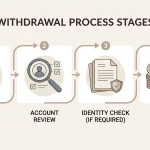
Before depositing, check the game’s stake options and the operator’s terms. For online slots in Britain, the maximum stake in a game cycle is £2 for players aged 18 to 24 and £5 for those aged 25 or over. Operators must verify a customer’s age before allowing a deposit. They may also ask for information or documents to confirm identity, including when a large win is being processed. That can mean a payout takes longer than the spin that produced it.
Withdrawal Timelines
Depending on the method, debit-card withdrawals may take 1–3 working days, e-wallets may take hours, and bank transfers may take 3–5 working days or longer.
A progressive jackpot win is not necessarily sent as one immediate payment. A specialist review reports that a large jackpot withdrawal may involve extra checks and, depending on the terms, be paid in scheduled instalments over several years. Read the specific game and operator rules before playing; don’t assume that a displayed jackpot figure means the whole amount will arrive in your account at once.
Withdrawal estimates also depend on the payment route. A specialist review gives debit-card withdrawals as taking 1–3 working days, e-wallet withdrawals as taking hours, and bank transfers as taking 3–5 working days or longer. Treat those as reported examples, not a promise for your account: processing checks, the payment method and the operator’s terms can all matter. The cashier’s current information is the useful place to check.
I’d also keep the idea of a “strategy” in proportion. Choosing a stake you can afford and understanding how a payment works are sensible practical steps; neither changes the game into a reliable way to make money. If you’re trying new progressive slots, check the rules for that particular title and the real-money account before you play. A familiar-looking game can still have different terms attached to its jackpot and withdrawals.
The boring bit matters. A win is only useful if you know how it can be claimed, how verification may affect timing, and whether payment is made in one go or in stages. Check first. Then decide whether the wager is still worth it.
Progressive Slots in the UK: Licensing and Player Controls
When I see a jackpot advertised, I try to separate the game from the rules around who can offer it. In Great Britain, the UK Gambling Commission is the sole regulator for commercial gambling. Its remit covers remote gambling offered to consumers there, even when the operator’s key equipment is located elsewhere.
The Commission issues operating licences to gambling businesses and personal licences to individuals working in certain operating roles. For you, the practical point is straightforward: online gambling is legal in the UK only through sites holding the relevant UK Gambling Commission licence. Before depositing, check the operator’s details on the Commission’s public register. A familiar game or polished website is not proof of a licence.
UK Casino Sites for Slots: What to Check
Controls matter just as much as the licence. UKGC-licensed operators must provide tools such as deposit and loss limits, session reminders, self-exclusion and access to support resources. New customers must be prompted to set a financial limit before making their first deposit, and account-level limit controls must remain accessible. These are not jackpot features; they are ways to put boundaries around play.
Operators must also verify a customer’s age before allowing them to deposit. Online gambling is for people aged 18 and over when the operator holds a UK Gambling Commission licence. I used to treat account controls as something to deal with later. That was backwards: setting a limit while you are calm is more useful than trying to make a clear decision after a long session.
Self-exclusion is a stronger step than setting a spending limit: it is intended for someone who wants to stop gambling, not just adjust their budget. Support resources are there if gambling is causing harm, and asking for help is a sensible move, not a failure.
Legal Requirement
Online gambling is legal in the UK only through sites holding a relevant UK Gambling Commission licence; always check the public register before depositing.
One detail worth keeping straight: the Commission’s remote-gambling remit is specifically described in relation to consumers in Great Britain. Its broader role covers gambling activity in the UK, but the Gambling Act 2005 does not apply to Northern Ireland. The rules are not a substitute for checking the actual operator. A licence is the starting point.
What Does “Penny Progressive” Mean?
“Penny progressive” can sound like a jackpot built for penny-sized wins. That is an easy reading, but it confuses the contribution with the prize. The word “penny” points to a small slice of a wager going into the progressive pool; it does not tell you that the jackpot itself is small.
Progressive jackpot slots typically send between 1% and 3% of each wager to that pool. So the amount added from one spin may be modest, while contributions from many wagers build the prize. The label describes the funding idea, not a promise about what you could win.
I used to take “penny” as a clue about the size of the whole game. It isn’t. A small contribution per wager can still feed a substantial jackpot, and the phrase on its own does not tell you the pool’s current value or how a particular game pays it out. Check the game information rather than treating the name as a measure of the prize.
There is another possible mix-up: “penny” may make you think the game necessarily accepts a one-penny stake. The phrase alone does not establish the stake options. Look at the game’s displayed bet controls and rules to see what you can actually wager. Small contribution, different question.
When you see a progressive slot described as a penny game, read that as a hint about how a portion of wagers may feed the jackpot, not as a guarantee about the stake, the jackpot size or your likely return. Those are separate details. “Penny” is a label, not a forecast.
RTP in UK Casino Slots: What the Figures Mean
Progressive vs Non-Progressive Slots: Where the Payout Goes
The difference between progressive slots and non-progressive slots is what happens to part of each stake. In a progressive jackpot slot, a portion of wagers feeds a prize pool that can grow as people play. A non-progressive slot has no such shared jackpot pool: its payouts come from the game’s own prize structure.
That distinction can change how the base game is presented. Progressive titles often have a lower base-game RTP, with figures in the 88%–92% range. Part of the payout is directed to the jackpot pool instead. That does not mean every spin pays less by a fixed amount, or that the growing prize makes up for the difference for any particular player. It describes how the game allocates its expected payout.
A progressive slot may also direct between 1% and 3% of each wager into its jackpot pool. The contribution is small beside the full stake, but it accumulates across play. With a non-progressive game, there is no growing pool receiving that share; the game’s payout stays within its own structure.
I used to look at a large jackpot figure and treat it as if it were extra value on top of everything else. It isn’t that simple. The jackpot is part of the payout design, while the base game has its own returns and features. A non-progressive slot can therefore make more sense if you care about the ordinary game and would rather not have part of its payout allocated to a growing prize.
Neither format tells you what your next spin will do. The useful comparison is where the potential payout goes: into a shared jackpot as well as the base game, or into the non-progressive game’s own payouts. No magic upgrade.
What should I look for in a progressive jackpot slot?
Check how much of each wager goes to the jackpot, how the jackpot is triggered, and whether a minimum bet is needed to qualify for the top tier. Progressive slots often have a base-game RTP of 88%–92%, with 1%–3% of each wager typically added to the jackpot pool.
Are progressive jackpot slots worth playing?
They may appeal to you if you value the chance to win a growing jackpot, but the base-game RTP is often 88%–92% because part of the payout goes towards the jackpot pool.
Do all UK casinos offer the same progressive jackpot games?
No. Game availability varies by operator and can change as providers update their catalogues. When operators carry the same progressive slot as part of its network, their players contribute to the shared jackpot pool.
How fast are progressive jackpot withdrawals paid out?
Debit card withdrawals typically take 1–3 working days, e-wallet withdrawals can take hours, and bank transfers often take 3–5 working days or longer. Large jackpot payouts may need extra verification and can be paid in instalments over several years.
What are the UK online casino licensing requirements?
The UK Gambling Commission issues operating licences to businesses and personal licences to individuals involved in operating gambling in Great Britain. Licensed UK operators must also offer responsible gambling tools, including deposit and loss limits, session reminders, self-exclusion and access to support resources.
What licensing and regulations apply to online casinos in the UK?
The UK Gambling Commission regulates commercial gambling in Great Britain, including remote gambling offered to consumers there regardless of where the key equipment is located. It issues operating licences to businesses and personal licences to individuals.
Games

Aviator Casino Game UK: Licensing and Play Guide
A practical look at licensing, slot rules, cash play and the limits of claims about...

3-Reel Slots in the UK: How to Find a Game
Lobby labels and artwork can be misleading, so check the game details, rules and preview...

Five-Reel Slots UK: Online Play and Safety
Five reels describe a game's format, while the UK Gambling Commission's public register helps verify...

Bonus buy slots in the UK: demos, stakes and limits
A practical guide to demo play, feature costs, volatility and session limits, with clear boundaries...

High Volatility Slots in the UK: How They Work
High-volatility slots tend to pay less often, with larger wins when they land; that pattern...

Low-Volatility Slots in the UK: RTP and Real Sessions
RTP describes a theoretical return over extensive play, while volatility shapes how results may vary...

Progressive Jackpot Slots: How They Work and Pay
Progressive slots pool part of wagers into a growing prize, while game rules, casino networks...

RTP in UK Casino Slots: What the Figures Mean
A slot’s RTP is a theoretical average across repeated play, while results in any individual...

Best Video Slots UK: How the Games Work
A practical guide to reel patterns, bonus features, browser play and the difference between demo...

Casino Dice Games in the UK: Rules and Formats
Dice-themed games can follow different rules and formats, making the instructions and platform terms important...

Chicken Road game in UK casinos: format guide
The game’s name and artwork do not establish its format; the way it is played...

Classic Slots Online in the UK: How They Work
Learn how reel combinations, paytables and familiar extras shape classic slots, and why a simple...

Crash casino games in the UK: regulation and play
The guide distinguishes UKGC-regulated operators from offshore sites and outlines checks on games, payments, demos...

Fruit Machine Slots UK: Pub Cabinets to Online
Online fruit slots keep familiar symbols and spins while replacing the physical cabinet with software,...

UK Casino Sites for Slots: What to Check
From operator authorisation and published game details to wagering terms and session limits, the guide...

Highest RTP Slots in the UK: How the Figures Work
RTP is a long-run mathematical expectation, while reel design, volatility and game settings can shape...

JetX Casino Game in the UK: What to Check
A look at JetX’s category label, demo limits, UK casino context and the checks to...

Mines Casino Game UK: Rules, Licensing and Risks
A Mines game’s name does not establish whether its operator holds the licence required to...

Online Casino Games for Real Cash in the UK: What to Know
A practical guide to slot odds, withdrawal routes, spending limits and bonus terms for UK...

Penny Slot Machines in the UK: Costs and Play
A practical guide to low-stake slots, covering total spin costs, free play, randomness, RTP and...

Plinko Casino UK: Real-Money Play and Regulation
A practical look at Plinko randomness, free play, payments and the difference between UKGC-regulated operators...

Online casino payouts in the UK: how RTP works
RTP describes a slot’s theoretical long-run return, not the result of an individual session or...