British casinos not on GamStop: what the label means
 Available in GB

The meaning of “British casino” can vary, and a site accessible in the UK is not necessarily covered by the same gambling controls.
Table of Contents
- What “Online British Casinos” Means in a GamStop Search
- UK Casino Sites and the Licence Question
- What “Best” Can Mean When UKGC Protections Aren’t There
- Why a Casino May Not Be on GamStop — and What That Doesn’t Mean
- UK Players, GamStop Eligibility and the Exclusion Period
- “Top” Features Aren’t a Substitute for Gambling Controls
- Free Spins: Read the Wagering and Game-Weighting Terms
- New Casino Sites and the Licence Behind the Launch
- Reviews, KYC and the Reality of Getting Paid
- No-Deposit Bonuses: The Terms That Can Change the Value
- Casino Types
What “Online British Casinos” Means in a GamStop Search
When people talk about British online casinos, they can mean two different things. Sometimes they mean casinos that operate under the rules applying in Britain. Sometimes they mean any casino a person in Britain can reach on a phone or laptop. Those descriptions sound close, but they do not identify the same group of sites.
That distinction matters if you have registered with GamStop. The service does not cover every gambling website that happens to be accessible from a British address. Its reach is tied to the UK Gambling Commission’s jurisdiction. A casino within that system must treat a registered user as excluded from gambling there. A site beyond that system is not automatically part of the same arrangement.
I used to read “UK online casino” as a simple location label: if I could open the site while sitting in the UK, I assumed it belonged in the British market. That was too loose. Being reachable here and being covered by the UK’s gambling controls are separate things. A website’s appearance, currency options or familiar wording does not tell you which framework applies to it.
GamStop is a self-exclusion service with a defined scope, not a universal switch for every online casino. When you enrol, the restriction applies to gambling establishments licensed by the UK Gambling Commission. So the practical question is not merely whether a casino is available to you; it is whether the operator sits within the regulator’s jurisdiction and therefore within GamStop’s coverage.
Online Casino With No Sister Sites in the UK
That is the basic meaning behind phrases such as “casinos not on GamStop”. They describe a relationship to the exclusion scheme, not a guarantee about a site’s quality, fairness or suitability. The phrase can be useful shorthand, but it leaves out the most important context: a casino may be outside the scheme because it is outside the UKGC’s reach. The absence of a GamStop block, by itself, does not tell you what protections the site offers.
It also helps to separate the location of the player from the reach of the system. A British resident can encounter websites that are not part of the UKGC-regulated group. That does not make those websites British online casino sites in the regulatory sense. It only means a person in Britain can find or access them. The everyday label “online British casinos” can blur those categories, so I would not use it as a reliable way to work out whether GamStop applies.
There is a similar trap in the word “online”. People often treat the internet as one shared space, as if a restriction attached to an account must follow that person from site to site. It does not work that way. GamStop’s coverage depends on the establishments within its regulatory scope; it is not a technical barrier that follows a user across the entire web.
So if you are trying to understand what a British casino online means in this context, start with the boundary rather than the branding. Ask whether the casino is within the UK Gambling Commission’s jurisdiction. That is the point relevant to GamStop. A British-sounding name, a British-facing page or the fact that a site loads for you cannot settle that question on its own.
Foreign Casinos for UK Players: Rules and Risks
This is also why lists headed “best British online casinos” can be hard to interpret. One list may mean UKGC-regulated operators; another may use “British” loosely for sites that accept people in Britain. Those are not interchangeable descriptions, especially if self-exclusion is part of your decision. I would not let a familiar label do the checking for me. Small wording, big difference.
None of this means that every reader uses the same phrase in the same way. A person might say “UK online casino” and simply mean a casino they have heard of or can access. Someone else may mean an operator regulated in Britain. In ordinary conversation, both uses are understandable. But when GamStop is involved, the second meaning is the one that matters: the service covers gambling establishments under the UK Gambling Commission’s jurisdiction.
Keep that boundary in mind as you read any claim about a site being on or off GamStop. The label tells you about its connection to the exclusion scheme; it does not, on its own, explain why the site falls outside that scheme or what that means for the player. For this first distinction, that is enough: “British” can describe the player, the audience a site appears to address, or the regulatory system. Only the last of those tells you whether GamStop’s restriction applies.
Casino Without a Swedish Licence: UK Guide
UK Casino Sites and the Licence Question
The phrase “UK casino site” can describe two different things: a casino licensed to serve customers in Great Britain, or a site that a person in the UK can reach online. Those are not the same. I used to treat a familiar-looking website, a British flag on its page or a choice of pounds as clues that it was a British operator. They tell you little about the licence.
The key question is not simply where a casino is based. It is whether the operator is authorised to offer real-money gambling to customers in the relevant part of the UK. Remote gambling operators serving the British market must hold a licence from the UK Gambling Commission (UKGC), even if the business itself is located elsewhere. A foreign address does not, by itself, put an operator outside that requirement.
That distinction matters when you come across a site that accepts UK customers but does not show a UKGC licence. The fact that the site is accessible, or that it lets someone register, does not make its offer lawful. An operator offering gambling services to UK residents without the required UKGC licence is acting illegally. In other words, the licensing question is about the operator’s conduct, not just the player’s ability to open a page.
A foreign licence is not a UKGC licence
Some casinos that do not hold a UKGC licence may instead be licensed in another jurisdiction, such as Malta, Gibraltar or Curacao. That is a separate authorisation issued under another regulator’s system. It should not be described as a UK licence, and it does not replace the UKGC licence required for an operator serving the British market.
Non-UK Regulated Casinos: What UK Players Should Know
I find it useful to keep two questions apart: “Who issued this licence?” and “Is the operator authorised to serve customers here?” A site may answer the first by displaying a foreign regulator’s name, while the second still raises a problem. A licence badge or a line in the footer is not enough on its own to establish that the operator is permitted to offer services in Great Britain.
This is where terms such as “trusted British casinos” can blur the issue. A polished site may look local without being licensed locally. Likewise, a casino might describe itself as international or list a licence from another jurisdiction, but that does not tell you that it has the UKGC authorisation needed to serve British customers. The label is not the licence.
The player and the operator are not in the same position
It is easy to read “illegal” and assume it means the same thing for everyone involved. Here, the important legal distinction is between the operator offering gambling to UK residents without the required licence and an individual player accessing an online casino licensed outside Great Britain. UK players may gamble at online casinos licensed elsewhere; that does not make the unlicensed operator’s offer lawful in the British market.
Illegal Offer
An operator offering gambling services to UK residents without the required UKGC licence is acting illegally.
So, when comparing what are called British casino sites, do not stop at whether the website loads or whether it accepts your details. Those facts show access, not authorisation. A site can be technically available to a person in the UK while still lacking permission to offer its service to customers here. That is the bit I once skimmed past. It matters.
Nor does a foreign licence automatically turn a site into a “UK casino”. It identifies the jurisdiction under which that operator says it is licensed. The operator’s location, the regulator named on its site and the market it is offering to are related questions, but they are not interchangeable. If a casino claims to serve British customers, the relevant issue is whether it holds the required UKGC licence.
That applies whether you are looking at a long-established brand, a newly launched site, or a page advertising British casino bonuses and British slots. Promotions, game titles and a British-themed design do not settle the licensing question. “Made for British players” is a marketing phrase; it is not evidence of UKGC authorisation.
I would not use a list labelled “best UK casino sites” or “top British casino sites” as a substitute for checking the operator’s status. A ranking can make a site look established, but popularity or a confident review does not change which regulator has authorised it. The same goes for a single “best British casino site”: that phrase may sound decisive, while leaving the most important legal question unanswered.
The practical takeaway is narrow but important: distinguish a casino that is licensed to serve the British market from one that can merely be reached from here. A foreign licence and an accessible website do not erase the UKGC requirement for operators serving British customers. Keep those points separate, and the licence question becomes much harder to dress up as a branding detail.
What “Best” Can Mean When UKGC Protections Aren’t There
If you’re considering a casino outside GamStop, check the available details carefully before deciding whether it suits you. This reference focuses on the payout-speed information provided for each operator.
1. Amunbet
Payout speed: 1-3 business days Amunbet’s listed payout speed is 1–3 business days. You can use that as a reference when considering how quickly withdrawals may be processed.
2. Revery Play
Payout speed: 1-3 business days Revery Play lists a payout speed of 1–3 business days. This is the available timing detail for you to consider.
3. EvoSpin
Payout speed: 1-3 business days EvoSpin’s stated payout speed is 1–3 business days. You can factor this timeframe into your decision.
4. Britsino
Payout speed: 1-3 business days Britsino lists payouts as taking 1–3 business days. That is the available information about its payout timing.
5. SpinFormula
Payout speed: 1-3 business days SpinFormula’s listed payout speed is 1–3 business days. You can consider this timeframe when assessing the operator.
6. WinBeast
Payout speed: 1-3 business days WinBeast states a payout speed of 1–3 business days. This is the only supplied detail about the operator.
7. SlotoSport
Payout speed: 1-3 business days SlotoSport lists a payout speed of 1–3 business days. You have this timing detail to refer to when considering it.
8. NightLuck
Payout speed: 1-3 business days NightLuck’s stated payout speed is 1–3 business days. The supplied information does not provide further details.
9. x3bet
Payout speed: 1-3 business days x3bet lists payouts as taking 1–3 business days. You can use this as its available payout-timing reference.
10. Zombillion
Payout speed: 1-3 business days Zombillion’s listed payout speed is 1–3 business days. This is the only supplied fact to guide your assessment.
“Best” is a slippery word on a casino page. It can mean the nicest-looking app, the biggest welcome offer, a familiar set of games or a quick-looking cashier. Those things may matter to you, but they do not tell you what happens when a withdrawal is disputed or a promotion is interpreted differently from how you expected.
I used to treat a confident review as a kind of reassurance. A neat score, a list of pros and cons and a few glowing quotes looked like someone had done the hard checking for me. It hadn’t. A review can describe what a site says it offers; it cannot make the protections associated with a UK Gambling Commission licence appear where they do not exist.
That is the point to keep in view when weighing claims about casinos not on GamStop. Playing at one is not a criminal offence for a player, but these sites do not provide the consumer protections that come with a UKGC licence. They operate outside that regulatory framework, and may not have responsible-gambling tools that are mandatory for UKGC-licensed operators. A smooth design or a familiar brand name does not change that.
Read the claim, not the adjective
When a review calls a casino “trusted”, ask what the word is based on. Is it describing a clearly explained process, or is it simply repeating the operator’s own language? Is the review specific about what it checked, or does it lean on broad claims such as “safe”, “fast” and “best”? If the evidence is vague, the praise is not much use.
The same goes for “best British casino bonuses”. A large headline figure says little about whether an offer suits you or whether its terms are workable. The value depends on the conditions attached, not just the number printed beside a bright button. I have been drawn in by the headline before. The small print was less impressed with me.
Reviews of games, slots and apps need the same scepticism. A long catalogue may look attractive, but quantity alone does not establish that a casino is dependable. Nor does an app-like interface tell you what protections apply. A familiar game, a polished mobile page and a useful-looking rewards screen are features to assess; none is a substitute for oversight.
If you are comparing payout claims, separate the promise from the actual terms and process. A review saying “quick withdrawals” is not a guarantee that your own payment will arrive quickly. Consider whether the explanation is concrete and whether it mentions what could affect a payment. If it only repeats a slogan, treat it as advertising dressed up as a verdict.
“Legit” is not the same as “protected”
People use “legit” to mean different things: that a site exists, that it accepts registrations, that it pays some customers, or that a regulator oversees it. Those meanings are not interchangeable. A casino can look operational and still sit outside the protections a UK player may expect from a UKGC-licensed site.
That distinction matters more than whether a reviewer calls it one of the best British casinos. “British” in a page title or a localised interface does not itself establish UKGC oversight. And a positive review cannot promise you an effective remedy if something goes wrong. The practical question is not whether a page sounds convincing; it is what protection stands behind the claim.
I would also be cautious with rankings that present a single winner as if every player values the same thing. One person may care about a particular game; another may focus on the app or the cashier. Those preferences can help you sort features, but they do not turn a site outside the UKGC framework into an equivalent choice for consumer protection.
So when you see a list of the “best” sites, read it as a set of claims to test, not a safety certificate. Look for clear distinctions between promotional language and verifiable detail, and remember what is absent: the consumer protections associated with a UKGC licence. No badge, bonus or glowing review can fill that gap.
Reviewing "Best" Sites
- A review cannot create UKGC protections where they do not exist.
- “Trusted” or “legit” labels are not substitutes for regulatory oversight.
- Rankings are sets of claims to test, not safety certificates.
- Consumer protections associated with a UKGC licence cannot be replaced by bonuses or design.
Why a Casino May Not Be on GamStop — and What That Doesn’t Mean
A casino may be absent from GamStop because it operates outside the UK Gambling Commission’s reach. GamStop’s block applies to participating establishments licensed by the Commission; a casino that is not regulated by the UKGC is not required to check or enforce a GamStop exclusion. That explains the gap. It does not tell you whether the site is trustworthy, suitable for you, or likely to handle a problem fairly.
I used to treat “not on GamStop” as if it meant a site had simply slipped past an administrative net. That was the wrong way round. It means the exclusion service does not control that operator, and the protections attached to the UKGC framework may not be there either. The label is a description, not a seal of approval.
Absence is not evidence of safety
A site can be outside GamStop for reasons connected to its regulatory location and obligations. That fact alone says nothing reassuring about how it handles disputes, protects your money or responds when gambling stops feeling manageable. Non-GamStop casinos operate outside the UKGC framework and may lack safeguards that UK-licensed operators are required to provide.
Nor does a polished website settle the question. A confident welcome message, a prominent bonus or a claim that a casino is among the “top” British online casinos is marketing, not independent proof. “Top” can mean little more than visible or generously promoted. I’ve learned not to confuse a familiar-looking page with meaningful protection.
There is another practical difference: if you use a casino outside the UKGC system, you may not have access to UK-based gambling support through that operator. If you are already trying to stop, that gap matters. A site’s willingness to accept a registration should not be mistaken for a sign that gambling there is safe for you.
Attempts to get around an active exclusion
One way people get past GamStop is by opening an account with an establishment that does not cooperate with the service. That is precisely why “not on GamStop” can appear in searches, but it is not a workaround I would recommend. If you registered because you wanted gambling kept out of reach, finding another door can undo the boundary you set for yourself.
Some other methods have also been reported. The UK publication neconnected.co.uk has described attempts involving another person’s personal details and tools such as VPNs, anonymous proxies or the TOR browser. These are reports of possible behaviour, not a promise that any method works. Using somebody else’s information can create serious problems, and trying to disguise your location may breach a site’s terms or lead to account complications. I’m not going to turn those reports into a how-to.
The same publication has reported on cryptocurrency gambling services that may not require registration or identity checks. That should not be read as a reliable route around an exclusion. Low friction is not protection, and a lack of checks can leave you with fewer ways to resolve trouble.
Other people turn to land-based gambling, or wait until their chosen exclusion period has ended before taking any further step. Neither changes what the exclusion is for: putting distance between you and gambling while it is active. If you are looking for a way around it, pause before acting and contact a support service instead. A moment of access can have consequences that last longer than the urge.
Attention Finding a way around an active GamStop exclusion can undo the boundary you set for yourself and may lead to serious account complications.
The key distinction is simple: a casino may not be on GamStop because it is outside the service’s regulatory reach. That absence does not make it safe, approved or a good fit—and it does not make bypassing an active exclusion a sensible choice. No shortcut here.
UK Players, GamStop Eligibility and the Exclusion Period
GamStop is available to UK residents. If you live elsewhere, you cannot register for the service, even if you are familiar with it or have used UK gambling sites before. That eligibility rule is easy to overlook when people talk about self-exclusion as though it works the same way for everyone.
For eligible residents, the choice of exclusion period is six months, one year or five years. Those are meaningful differences, not just options on a form. I’d think carefully about the length before confirming it: the point is to create a barrier for a period you have chosen, not to put a temporary pause in place that you can casually undo when the mood changes.
That last part matters. Once a GamStop self-exclusion is active, you cannot shorten it or cancel it before the selected period ends. If you choose five years, for instance, you cannot later switch to one year because you feel ready to gamble again. The commitment remains in place until the period you selected has run its course.
I can see why that rule might feel frustrating in a moment when your view of gambling has changed. But treating the choice as reversible would weaken the whole idea of setting a firm boundary. So take the selection seriously rather than choosing the longest option on impulse or the shortest one because it feels less daunting. Neither choice is automatically right for everyone.
It also helps to separate two questions: whether you are eligible to use GamStop, and how long you want the exclusion to last. UK residence determines the first; your selected period determines the second. The available periods are clear, but the decision belongs to you. Give yourself time to consider what you want the restriction to do before registering.
If you are already excluded, the fixed end date is the key limit to remember. Looking for a way to end the restriction early is not the same as changing your original choice; the selected period cannot be brought to an early close. That may be hard to sit with, but it is better to know the boundary plainly than to assume there is an exception waiting somewhere.
A self-exclusion period is not a prediction of how you will feel in the future. It is a commitment made now, while you are deciding what boundary you need. I would not treat the available options as a menu to rush through. Pick deliberately. Then let the period do its job.
“Top” Features Aren’t a Substitute for Gambling Controls
A slick British casino app, a busy games lobby or talk of big jackpots can make a site feel polished. I’ve learned not to mistake polish for protection. Bonuses and rewards tell you what the operator wants you to notice; the more useful question is what happens when you need to slow down or stop.
Casinos not on GamStop sit outside the UK Gambling Commission’s regulatory framework. They may lack responsible-gambling tools that are mandatory for UKGC-licensed operators, and there is no guarantee that a feature shown on one site will be available on another. A specialist review of non-UK sites reports that some may provide deposit or loss limits, session-time limits, reality checks, reminders and self-exclusion voluntarily. That is not the same as a requirement enforced across the market.
If you are checking a site, look for the controls themselves rather than a banner saying it takes responsible gambling seriously. Can you set a deposit limit? Is there a way to pause or exclude yourself? Are reminders visible while you play? Read what the site says about changing or removing those settings. A button in an account menu is not much use if its effect is unclear.
I once treated the presence of a limit as proof that I was in control. It wasn’t. Limits can help put a boundary around spending or time, but they do not make a site equivalent to one regulated by the UKGC, and they cannot guarantee that you will stick to a plan. Small print matters. So does whether the control is easy to find before you deposit, not after.
The same caution applies to support. People using casinos not on GamStop may not have access to UK-based gambling support through the operator, so do not assume that a familiar-looking help button connects you to a UK service. If you are already trying to stop gambling, a site’s voluntary tools are not a reason to sign up or keep playing.
Payment choices need their own clear-eyed check. If you use cryptocurrency, transfers are irreversible; a mistake in the wallet address can mean a permanent loss. That is a practical risk, not a responsible-gambling feature.
A “top” casino app, a generous-looking reward or a headline about jackpots cannot tell you whether the safeguards will work for you. I would judge the controls by what they actually let you do, and I would not treat their presence as a green light. No feature makes chasing losses safer.
Free Spins: Read the Wagering and Game-Weighting Terms
Free spins look simple: a promotion gives you spins on a slot, and any winnings may come with conditions. The catch is often what happens after that. If wagering applies, the games you choose can affect how much progress you make towards meeting it.
A slot may count towards wagering differently from a table game. Table games can contribute less than slots, or be excluded altogether. So a blackjack or roulette session might feel like it is putting your bonus winnings to work, while the promotion’s rules give it little or no credit. Small print. Big difference.
Do
- Check game-contribution rules before accepting a bonus.
- Read the wagering and game-weighting terms first.
- Verify if preferred games actually count towards requirements.
Don’t
- Base your decision on the number of free spins alone.
- Assume every bet advances the wagering requirement equally.
- Let a headline figure steer you into games you would avoid.
I used to read the number of spins first and the terms later. That order made the offer sound better than it was. Now I look for the game-contribution rules before deciding whether a free-spins promotion is worth my attention. Check whether the rules name particular games, distinguish slots from table games, or state that some games do not count. If the wording is unclear, do not assume every bet advances the same requirement.
This matters whether the offer is described as UK casino free spins or a British casino free spins bonus. The label tells you what is being advertised; it does not tell you how each game is weighted. Nor does a themed slot or a familiar-looking game change the promotion’s rules. The terms do.
Keep the distinction clear: “free” describes the spins, not necessarily unrestricted access to any winnings. A promotion can still have conditions, and the game-weighting clause can determine whether your preferred way to play helps satisfy them. If you mainly enjoy table games, a slot-focused offer may be a poor fit even when its headline looks generous. No magic in the label.
Also check which games the promotion permits before you start. Switching to another game without checking can leave you with wagering progress that is lower than you expected, or none for that activity. The useful question is not simply how many spins are offered, but which games count and how the rules treat them.
There is a separate issue with casinos not on GamStop. They operate outside the UK Gambling Commission’s framework, and may lack responsible-gambling tools that UK-licensed operators are required to provide. A familiar bonus format does not make those protections equivalent. Treat the offer and the operator as separate things to assess.
For me, the practical test is plain: read the game-weighting clause, then decide whether the eligible games are ones you actually want to play. If the terms only make sense after a gamble, I leave the offer alone. A bonus should not steer you into games you would otherwise avoid.
New Casino Sites and the Licence Behind the Launch
A fresh casino site can make its new slots and launch offers look like the main event. I used to get caught by that: a polished welcome page feels like evidence that somebody has checked the business. It isn’t. The first useful detail is the licence, not the launch date.
A casino operating outside the UK Gambling Commission’s system may hold a licence in a jurisdiction such as Malta, Gibraltar or Curacao. Those names are not interchangeable guarantees. Find the regulator named in the casino’s terms, then check the operator and licence details against that regulator’s official records. If the details are missing, vague or do not match, the glossy design does not fill the gap.
There is another distinction worth keeping straight. A site’s claim to be new or British does not establish that it is authorised to offer real-money gambling to people in Great Britain. Operators serving that market need the relevant UKGC licence. A foreign licence does not provide the same UK regulatory framework, and it may not bring equivalent consumer protection. Don’t treat “licensed” as a complete safety verdict.
The same applies when you are looking at new slot releases. A fresh title can be interesting, but it says nothing by itself about who runs the casino, which regulator oversees it, or what help is available if something goes wrong. Players using Casinos not on GamStop should not assume they can access UK-based support services through the operator.
Verifying New Casinos
- Find the regulator named in the casino’s terms.
- Check the operator and licence details against official records.
- Confirm the operator is authorised to serve the British market.
- Establish who is legally responsible for the site.
I now check the paperwork before I get distracted by the lobby. If I can’t establish who is responsible for the site and where its licence can be verified, I leave it there. New is not proof.
Reviews, KYC and the Reality of Getting Paid
A glowing review can make a withdrawal sound like the easy part. I’ve learned to look past the headline and ask what happens between pressing “cash out” and seeing the money arrive. The payment method matters, but so does the casino’s own processing stage.
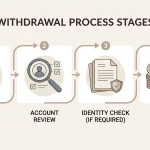
A specialist review of payment times reports that e-wallet withdrawals are generally faster than card withdrawals, while casino processing can take up to 24 hours. That is not a promise about every request: a casino may still need to check the account before releasing funds. Read the stated payment steps carefully, and treat a reported speed as an indication, not a guarantee.
KYC checks — identity verification — can also hold things up. A specialist review advises completing verification early rather than waiting until a withdrawal is pending. Follow the operator’s instructions and make sure the documents you submit are clear and consistent with your account details. It is a small bit of admin. Better before, not after.
Reviews of casinos not on GamStop need another reality check: these sites operate outside the UK Gambling Commission’s regulatory framework and may lack mandatory protections. A payout report does not establish that a site is safe or equivalent to a UKGC-licensed casino. Nor should you assume UK-based gambling support services can help with a dispute involving an operator outside that system.
When comparing British casino reviews and payouts, separate user reports from the operator’s stated processing policy. Look for details about verification and payment stages, not just claims of “fast” cashouts. British casino rewards may attract attention, but a bonus says nothing about whether a withdrawal will be straightforward. Keep the focus on what the review actually describes.
No-Deposit Bonuses: The Terms That Can Change the Value
A no-deposit offer sounds simple: a bonus without putting your own money in first. But the headline figure is only the start of the calculation. I’ve learned not to treat “free” as meaning straightforward.
Read the wagering requirement first. It says how much qualifying play is required before bonus winnings can be withdrawn. A specialist review source describes requirements around 30x to 40x as an industry average and anything above 50x as generally predatory. Those figures are a reference point, not a promise about any particular British casino site. Check how the operator defines the calculation and which balance it applies to.
Then look for the deadline. A bonus may have a time limit for completing wagering, and a short window can make an offer far less useful than its headline suggests. The terms may also set a maximum bet while the bonus is active. Going over it could affect your eligibility for the winnings, so check the rule before playing.
Finally, find the withdrawal cap. Some bonus terms limit how much of the winnings you can cash out, even after you meet the wagering requirement. That can change the real value of an offer more than the advertised amount does. Specialist reviews identify deadlines, maximum bets and withdrawal caps as terms to look for; read the casino’s own current rules before accepting anything.
There’s another distinction worth keeping in view: casinos not on GamStop operate outside the UK Gambling Commission’s framework and may lack safeguards required of UK-licensed operators. A bonus does not make that difference disappear. If you’re under an active GamStop exclusion, don’t use an offer as a way around it.
I’d judge the rules, not the banner. It’s less shiny.
Are casinos that bypass GamStop illegal for UK players to use?
No, playing at a non-GamStop casino is not itself a criminal offence for you. However, an operator offering gambling to UK residents without a UK Gambling Commission licence is acting illegally, and non-UKGC sites do not provide the same consumer protections.
What gambling sites are not on GamStop?
They are generally sites outside the UK Gambling Commission’s jurisdiction, such as casinos licensed in Malta, Gibraltar or Curaçao. A foreign licence does not authorise an operator to offer gambling to UK residents without the required UKGC licence.
What are casinos not on GamStop?
They are casinos that do not participate in GamStop, usually because they operate outside the UK Gambling Commission’s regulatory reach. They do not have to apply GamStop exclusions, and protections may differ from those at UKGC-licensed casinos.
How can players get around Gamstop?
Some people try to gamble through establishments that do not cooperate with GamStop, but doing so circumvents a self-exclusion safeguard. If you have self-excluded, you cannot shorten or cancel the restriction early; wait until your selected period ends.
Can I reverse a self-exclusion from GamStop early?
No, you cannot shorten or cancel a GamStop exclusion before the selected period ends. The available periods are six months, one year or five years.
Is it legal to play in casinos not blocked by Game Stop?
Playing at a non-GamStop casino is not itself a criminal offence for you. But an operator offering gambling to UK residents without a UK Gambling Commission licence is acting illegally.
What is Gamstop?
GamStop is a self-exclusion service for UK residents that blocks registered users from gambling at UK Gambling Commission-licensed establishments. Exclusions can be selected for six months, one year or five years.
Casino Types

Anjouan Casino Licence in the UK: What It Means
Anjouan licensing is separate from UKGC supervision, which affects how a casino’s regulatory status should...

Casino Apps in the UK: App or Browser?
Learn how browser and installed versions differ, and what to check around licensing, limits, bonuses,...

Foreign Casinos for UK Players: Rules and Risks
A guide to UKGC licensing, offshore claims, bonus terms, payment timelines and safeguards that may...

International casinos for UK players: legal checks
A practical look at operator licensing, bonus terms, crypto payments and withdrawal waits for UK...

Paying at a UK mobile casino with phone credit
Phone-credit payments use a mobile account to fund a casino deposit, with charges added to...

Offshore casino sites for UK players: key risks
Foreign licences do not replace a UK Gambling Commission licence for operators serving customers in...

Offshore Casinos for UK Players: Risks and Checks
A practical look at licensing, player safeguards, bonus conditions and payment routes for offshore casinos...

Casino Sites Not Registered with GamStop: What to Know
The guide explains why some casinos fall outside the scheme and how licensing, bonus terms,...

Casino Without a Swedish Licence: UK Guide
A guide to offshore licensing, player protections, dispute options, bonuses and payments for UK players....

Casinos That Bypass GamStop: What It Means
A casino outside GamStop does not apply its exclusions; that label alone says nothing about...

Curacao Casino Licence UK: What the Label Means
A licence from outside the UK does not replace the authorisation required to serve customers...

Gibraltar Casino Licence in the UK: What It Means
A Gibraltar licence signals a regulatory connection, but UK access, player safeguards and the operator’s...

Jackpot Mobile Casinos in the UK: How Slots Work
Jackpot labels can describe different prize structures, so compare how pools work alongside mobile play,...

Non-UK Licence Casinos: What the Licence Means
Licensing jurisdictions set different frameworks, so an overseas licence is not the same as permission...

Non-UK Registered Casinos in 2026: Licence Guide
A foreign licence does not authorise a casino to serve Great Britain; the operator’s regulatory...

Non-UK Regulated Casinos: What UK Players Should Know
The guide explains how UKGC authorisation differs from offshore licences and which protections may be...

Non-UKGC Casinos: Licensing and Risks Explained
Non-UKGC sites are not overseen by the UK Gambling Commission, and any other licence depends...

Online Casino With No Sister Sites in the UK
A sister-site connection can reflect shared ownership or technology, but it does not make two...

Online slots not on GamStop: what to check
The label describes a casino’s relationship with GamStop, while its licensing determines which protections apply....

Trusted Casinos Not on GamStop UK: What to Know
Understand the limits of trust claims, the protections outside the UKGC framework, and the risks...

USA Casinos for UK Players: What to Check
The guide explains how offshore status, licensing, bonus terms and payment routes affect British players....

VPN-Friendly Casinos in the UK: Access and Rules
A practical look at VPN access, casino terms, identity checks and Bitcoin withdrawals, without treating...